
EPOXY FLOORING SYSTEM FOR – HOSPITALS & PHARMACEUTICAL PRODUCTION ZONES
Introduction
Hospitals and pharmaceutical production facilities demand high-build, hygienic, and visually bright epoxy flooring systems that support strict cleanliness and safety standards. Floors in these areas must withstand continuous foot traffic, movement of light equipment, and frequent cleaning cycles using mild disinfectants—all while maintaining a smooth, seamless, and attractive surface.
The Epoxy Flooring System for – Hospitals & Pharmaceutical Production Zones has been carefully designed with visibility, hygiene, and safety in mind. Using Ressichem’s range of high-performance epoxy products, this system provides long-term durability, cleanliness, and aesthetic brightness, essential for healthcare and pharmaceutical environments.
Recommended Use Cases
- Pharmaceutical manufacturing units
- Hospital operation and recovery zones
- Laboratory corridors and sterile processing rooms
- ICU, nursing stations, and diagnostic areas
- Medical device assembly rooms
- Pharmaceutical packaging and cleanroom environments
Step-Wise System Description
Step 1: Surface Preparation
- Thorough surface preparation is essential to achieve a strong and lasting bond between the epoxy system and the concrete substrate.
- Ensure a sound, levelled concrete base of adequate strength
- Mechanically grind or shot blast to remove laitance, contamination, and weak layers.
- Repair cracks, joints, and surface defects using Ressichem crack fillers and various repairing materials.
- Clean thoroughly using an industrial vacuum.
- Verify that the substrate moisture content is below 5 % before proceeding.
Step 2: Application of Ressi EPO Primer LV
- Apply Ressi EPO Primer LV, a low-viscosity, solvent-free epoxy primer ensuring deep substrate penetration and superior adhesion.
- Mix resin and hardener thoroughly in the specified ratio.
- Apply evenly with a roller or brush, ensuring complete surface coverage.
- Avoid puddling and allow curing as per ambient temperature before applying the next coat.
Step 3: Application of Ressi EPO Mid Coat S – GP (Optional but Recommended)
- For levelling, added durability, and smoother finish, apply Ressi EPO Mid Coat S – GP.
- Apply at a minimum thickness of 1000 microns; 2000 microns are recommended for critical zones.
- Spread evenly using a notched trowel or squeegee, followed by back-rolling for uniformity.
- Allow to cure overnight before applying the final topcoat.
- This layer may be omitted where the surface is already level and smooth.
Step 4: Application of Final Epoxy Topcoat
Select the appropriate topcoat depending on whether a mid-coat is applied:
If Mid Coat Applied:
Apply Ressi EPO Gloss Might at a minimum thickness of 1000 microns. This provides a smooth, glossy, and hygienic surface ideal for hospitals and clean areas.
If Mid Coat Not Applied:
Apply Ressi EPO Gloss Plus at a minimum thickness of 2000 microns to achieve the necessary system build and performance in a single application.
- Mix resin and hardener thoroughly as per the manufacturer’s ratio.
- Apply evenly using a roller or notched squeegee for consistent film build.
- Allow 48–72 hours for light foot traffic and 7 days for full cure before chemical exposure or maintenance.
Step 5: Floor Markings (If Required)
- For demarcation of operational zones, aisles, or sterile boundaries, use Ressi EPO Gloss Might in a contrasting color applied as a roller coat.
- Ensure the floor surface is clean and fully cured before applying markings.
- Mask boundaries precisely for crisp, defined lines.
- Allow to cure completely before reopening the area to use.
Note:
- The total system thickness should be a minimum of 2000 microns.
- If no mid coat is used, apply Ressi EPO Gloss Plus directly over the primer to achieve the required build.
- For full technical details such as mixing ratios, pot life, coverage rates, and environmental conditions, always consult the product Technical Datasheets (TDS) prior to application.
System Advantages
- Hygienic & Seamless: Non-porous, easily cleanable surface ideal for sterile environments.
- Bright Gloss Finish: Enhances visibility and cleanliness perception.
- Durable & Long-Lasting: Withstands daily foot traffic and light equipment movement.
- Mild Chemical Resistance: Tolerates disinfectants, cleaning agents, and sanitizers.
- Low Maintenance: Easy to clean and recoat when necessary.
- Aesthetic & Safe: Smooth, reflective surface improves lighting efficiency and safety.
Maintenance Guidelines
- Clean routinely with mild, neutral pH cleaning solutions.
- Avoid harsh acids or solvents that may damage the finish.
- Clean up spills promptly to maintain surface brightness.
- Inspect periodically for wear and recoat as needed to maintain hygiene and aesthetics.
System Summary Table
| Parameter | Description |
|---|---|
| System Name | Epoxy Flooring System for – Hospitals & Pharmaceutical Production Zones |
| Area Type | Hospitals, Cleanrooms, and Pharmaceutical Production Areas |
| Traffic Exposure | Medium Duty |
| Primary Requirements | Hygiene, Gloss Finish, Mild Chemical Resistance, Cleanability |
| Primer | Ressi EPO Primer LV |
| Mid Coat (Optional) | Ressi EPO Mid Coat S – GP (1000–2000 microns) |
| Topcoat | Ressi EPO Gloss Might (with Mid Coat) / Ressi EPO Gloss Plus (without Mid Coat) |
| Marking Coat (Optional) | Ressi EPO Gloss Might (Roller Applied, Alternate Color) |
| Total System Thickness | Minimum 2000 Microns |
| Finish Type | Smooth, Gloss |
| Curing Time Before Use | 48–72 Hours for Mild Traffic / 7 Days Full Cure |
| Key Benefits | Hygienic, Reflective, Durable, Easy-to-Clean, Mild Chemical Resistant |
Conclusion
The Epoxy Flooring System for – Hospitals & Pharmaceutical Production Zones offers an ideal combination of hygiene, durability, and aesthetics for sensitive, high-visibility environments. The sequence — Surface Preparation, Ressi EPO Primer LV, (Optional) Ressi EPO Mid Coat S – GP, Ressi EPO Gloss Might or Ressi EPO Gloss Plus, (Optional) Ressi EPO Gloss Might for markings — ensures a seamless, clean, and safe flooring system for modern medical and pharmaceutical facilities.
System Summary
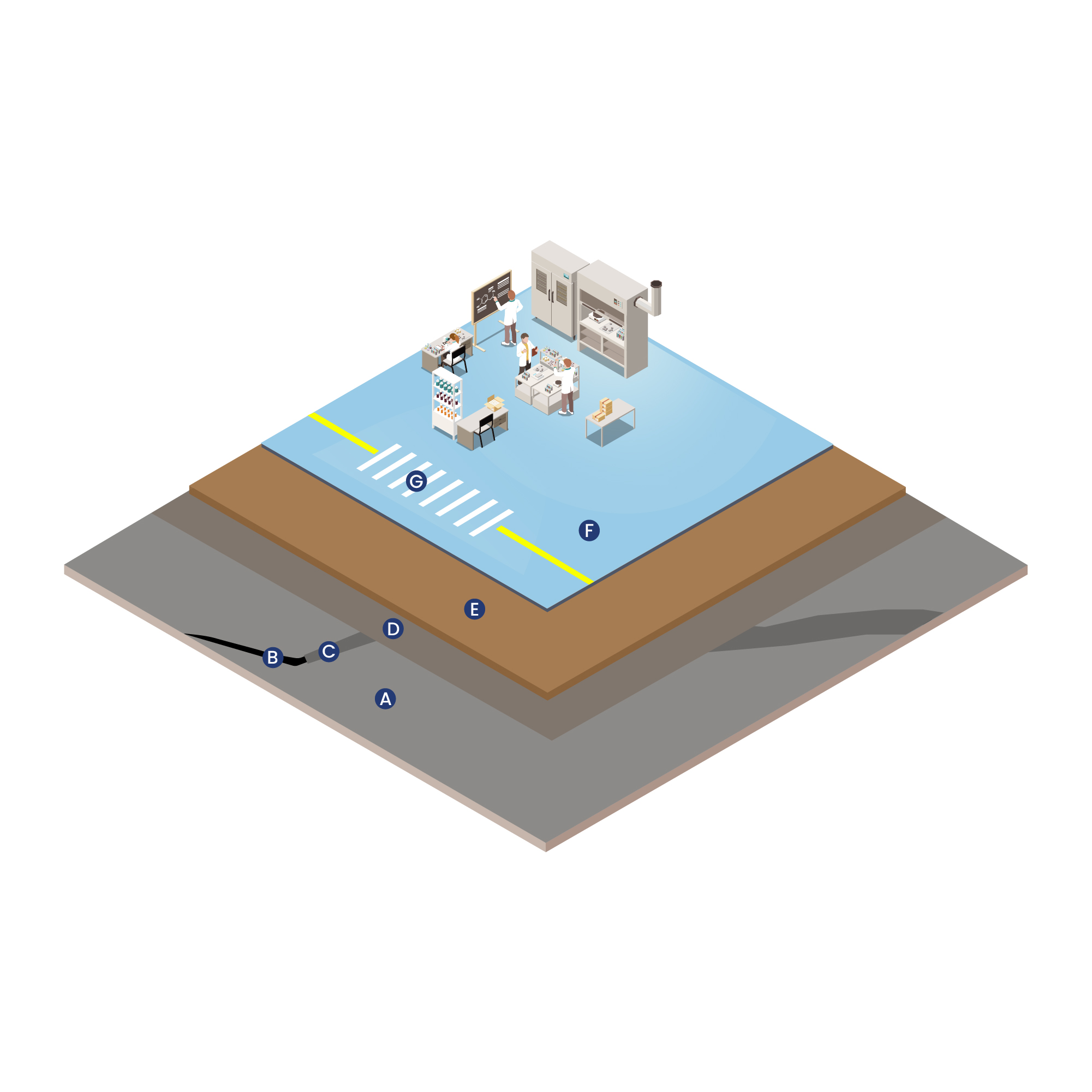
A Cementitious Surface: (Concrete slab or screed)
B Cracks and surface damage
C Crack Filler and Repairing Materials
D Ressi EPO Primer LV
E Ressi EPO Mid Coat S – GP
F Ressi EPO Gloss Might / Ressi EPO Gloss Plus
G Ressi EPO Gloss Might (Marking)