
EPOXY FLOORING SYSTEM FOR – HOSPITAL & CLINICAL (NON-CRITICAL AREAS)
Introduction
Hospital and clinical facilities require flooring systems that are hygienic, easy to clean, and durable, ensuring a safe and sanitary environment. In non-critical areas such as corridors, waiting rooms, consultation spaces, and administrative zones, the flooring should prioritize cleanability, appearance, and long-term service life, while offering resistance to regular foot traffic and cleaning cycles.
The Ressi EPO System – Hospital & Clinical (Non-Critical Areas) combines well-established primers, optional self-levelling layers, and a seamless epoxy topcoat to deliver a hygienic, smooth, and low-maintenance surface suitable for healthcare environments.
Recommended Use Cases
- Hospital corridors and waiting areas
- Outpatient clinics and consultation rooms
- Staff offices and reception zones
- Pharmacy preparation areas (non-sterile)
- Diagnostic and administrative laboratories
- Rehabilitation and physiotherapy rooms
Step-Wise System Description
Step 1: Surface Preparation
- Ensure the substrate is a sound, levelled screed of adequate strength (minimum 25 MPa).
- Mechanically grind or shot-blast to remove laitance and contaminants.
- Clean the surface to eliminate oil, grease, and dust.
- Fill surface cracks or voids with an epoxy repair mortar.
- Confirm the substrate moisture level is below 5 % before proceeding.
Step 2: Application of Ressi SLS Primer – 1 (if Required)
- Apply Ressi SLS Primer – 1, a latex-based primer that promotes bonding between the substrate and self-levelling layer (if used).
- Stir thoroughly before use.
- Apply uniformly by roller, brush, or spray.
- Avoid puddling; allow 2 – 4 hours to dry to a tack-free condition.
Step 3: Application of Ressi SLS 610 Self-Levelling Screed (if Required)
- Where surface irregularities exist, apply Ressi SLS 610, a thin, self-levelling cementitious screed.
- Mix with clean water using a low-speed mixer.
- Spread evenly using a trowel or gauge rake.
- Use a spiked roller to remove trapped air.
- Ressi SLS 610 does not require curing but needs 7 – 14 days to release moisture, depending on ambient conditions.
- Verify moisture levels are below 5 % before applying epoxy primer.
Step 4: Application of Ressi EPO Primer LV
- After confirming dryness, apply Ressi EPO Primer LV, a low-viscosity, solvent-free epoxy primer that penetrates and seals the substrate.
- Mix resin and hardener thoroughly in the prescribed ratio.
- Apply with a roller or brush ensuring uniform coverage.
- Avoid pooling and allow to cure overnight before top coating.
Step 5: Application of Ressi EPO Tough Might
- Finish with Ressi EPO Tough Might, a high-build, solvent-free epoxy coating designed for hospital and clinical environments requiring hygiene, durability, and ease of cleaning.
- Mix components thoroughly using a slow-speed drill.
- Apply in a single coat at a minimum thickness of 1000 microns, or more where required.
- Back-roll to achieve an even surface.
- Allow 48 – 72 hours before opening to mild traffic, and 7 days for full cure before maintenance cleaning or exposure to routine operations.
Note: For detailed information regarding mixing ratios, pot life, recoat intervals, coverage, and application environment, it is strongly recommended to refer to the individual product Technical Datasheets (TDS) for all materials used in this system before application.
System Advantages
- Hygienic & Seamless: Non-porous surface prevents bacterial accumulation.
- Easy Maintenance: Smooth finish simplifies cleaning routines.
- Durability: Withstands regular hospital foot traffic and trolley movement.
- Chemical Resistance: Resists mild cleaning and disinfectant agents.
- Aesthetic Finish: Smooth, semi-gloss appearance enhances cleanliness perception.
- Versatility: Suitable for all non-critical healthcare zones.
Maintenance Guidelines
- Use neutral, non-abrasive cleaning solutions.
- Avoid solvent-based or highly acidic products.
- Clean spills promptly to maintain hygiene.
- Re-inspect periodically and recoat if required for long-term aesthetics.
System Summary Table
| Parameter | Description |
|---|---|
| System Name | Epoxy Flooring System for Hospitals & Clinical (Non-Critical Areas) |
| Area Type | Hospitals, Clinics, and Healthcare Facilities (Non-Critical Zones) |
| Traffic Exposure | Light to Medium Duty |
| Primary Requirements | Hygiene, Cleanability, Durability |
| Optional Layers | Ressi SLS Primer – 1, Ressi SLS 610 (if required) |
| Primer | Ressi EPO Primer LV |
| Topcoat | Ressi EPO Tough Might |
| Total System Thickness | Minimum 1000 Microns (Single Layer or Above) |
| Finish Type | Smooth, Semi-Gloss |
| Curing Time Before Use | 48–72 Hours for Mild Traffic / 7 Days Full Cure |
| Key Benefits | Hygienic, Easy to Clean, Durable, Seamless Finish |
Conclusion
For hospitals and clinics in non-critical areas, the Ressi EPO System – Hospital & Clinical provides a seamless, hygienic, and easy-to-maintain epoxy flooring solution. The sequence — Surface Preparation, Ressi SLS Primer – 1 (if required), Ressi SLS 610 (if required), Ressi EPO Primer LV, Ressi EPO Tough Might — ensures a durable, aesthetically clean, and value-driven finish perfectly suited for healthcare environments without requiring advanced antistatic or high-abrasion properties.
System Summary
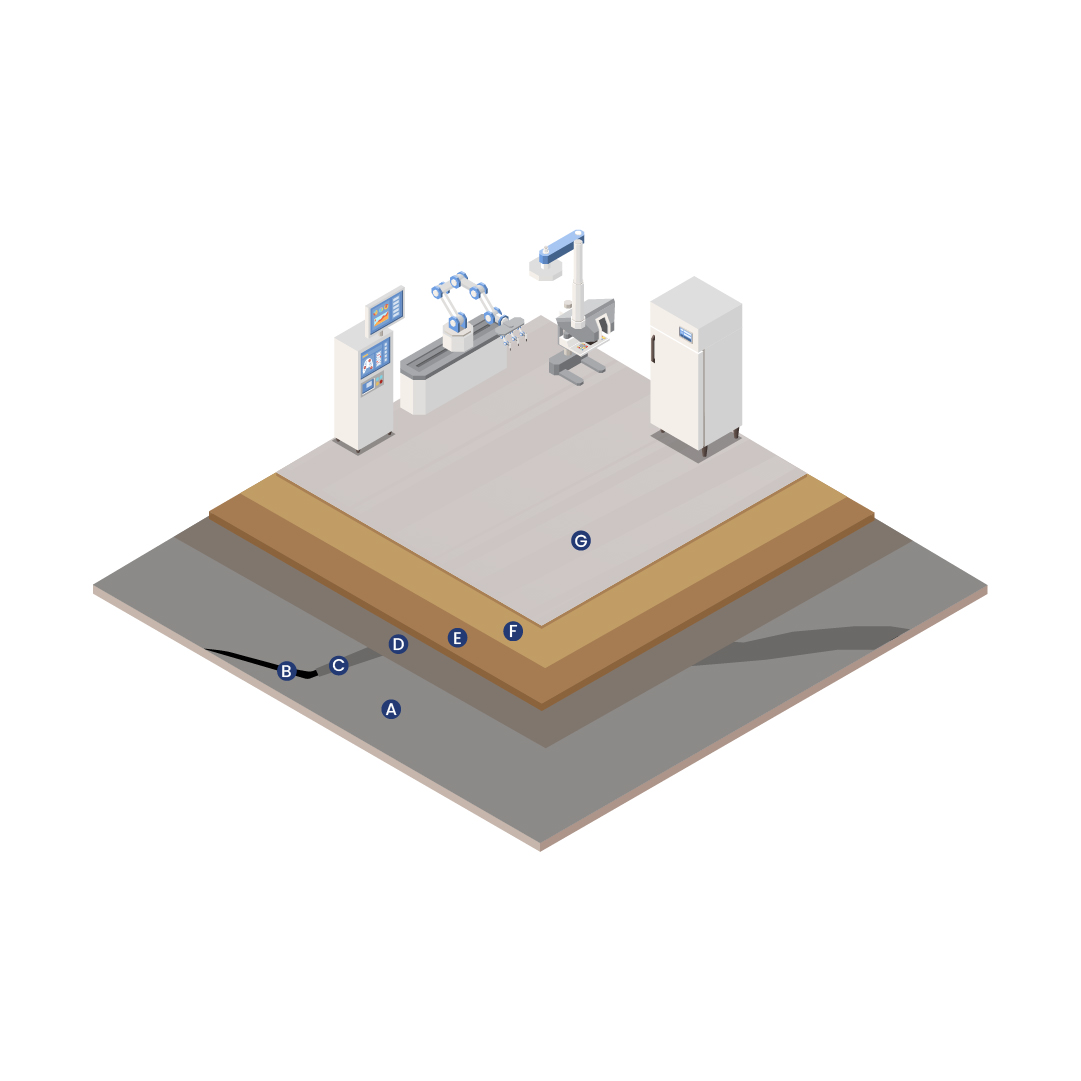
A Cementitious Surface: (Concrete slab or screed)
B Cracks and surface damage
C Crack Filler and Repairing Materials
D Ressi SLS Primer - 1 (Optional)
E Ressi SLS 610 (Optional)
F Ressi EPO Primer LV
G Ressi EPO Tough Might