
EPOXY FLOORING SYSTEM FOR – COLD STORAGE & FREEZER ROOMS
Introduction
Cold storage and freezer environments demand flooring systems capable of withstanding sub-zero temperatures, condensation, and thermal cycling without compromising integrity. The epoxy flooring in such facilities must maintain its adhesion, impact resistance, and dimensional stability even under freezing conditions.
It is critical to note that epoxy flooring materials must be applied under room temperature conditions. The epoxy system achieves its full mechanical and chemical properties only after complete curing — typically 7 days after application. Once fully cured, the area may then be gradually brought to its temperature-controlled environment.
Recommended Use Cases
- Cold storage warehouses and distribution centers
- Food preservation and processing facilities
- Freezer chambers and blast chillers
- Temperature-controlled pharmaceutical storage zones
- Meat, poultry, and dairy cold handling areas
Step-Wise System Description
Step 1: Surface Preparation
Substrate evaluation and repair are critical to ensure long-term durability and adhesion, particularly under temperature fluctuations.
- All necessary surface repairs, including crack filling or substrate restoration, must be completed prior to the application of any epoxy flooring materials. Ressichem offers a range of suitable crack fillers and repair compounds, including non-shrink cementitious grouts, specifically designed for surface preparation and repair.
- Concrete strength verification must be performed by the consultant based on anticipated load and operational use.
- Test substrate integrity using destructive (core sampling) and non-destructive (Schmidt Hammer) methods.
- For major repairs (≥12 mm), use Ressi NSG 710, a high-strength, non-shrink cementitious grout.
- For minor surface imperfections, use a blend of Ressi EPO Primer LV and Ressichem’s washed, graded, and completely dried (zero-moisture) silica sand to form a dense epoxy-sand repair mortar.
- Mechanically prepare the surface via shot blasting or diamond grinding.
- Ensure the substrate is clean, dust-free, and completely free from oil or grease contamination.
- For previously used or aged floors, ensure complete removal of oil or grease penetration before coating.
Step 2: Application of Ressi EPO Primer LV
- Apply Ressi EPO Primer LV, a low-viscosity, solvent-free epoxy primer providing excellent adhesion and substrate penetration.
- Mix resin and hardener precisely as per the product datasheet.
- Apply using a trowel or epoxy squeegee ensuring uniform coverage.
- Allow the primer to cure completely before proceeding to subsequent layers.
Step 3: Application of Ressi EPO Mid Coat S – GP
- Apply Ressi EPO Mid Coat S – GP, a high-build, general-purpose epoxy mid-layer that enhances the mechanical performance of the flooring system and builds overall system thickness.
- Apply using a notched trowel or epoxy squeegee to ensure even distribution.
- Minimum recommended thickness is 1000 microns, though 2000 microns is preferred for improved load-bearing and durability under freezer conditions.
- Allow complete curing before applying the final topcoat.
Step 4: Application of Final Epoxy Topcoat
- Apply Ressi EPO Floor Plus, a durable, high-build epoxy topcoat designed for high mechanical strength and low-temperature resistance.
- For projects requiring custom colors and enhanced aesthetic finishes, use Ressi EPO Floor Plus.
- For cost-effective solutions in standard grey, use Ressi EPO Floor Plus Econo — offering identical performance with limited color availability.
- Minimum thickness: 2000 microns.
- Allow 48–72 hours before light foot traffic and 7 days for complete curing before temperature control activation.
Step 5: Floor Markings (If Required)
- Where required, apply Ressi EPO Gloss Might in contrasting colors for demarcation or safety zones.
- Apply using a roller after full system cure.
- For economical solutions, Ressi EPO Roll Coat may be used in alternate colors.
Note:
- The total system thickness must be a minimum of 3000 microns.
- Epoxy flooring must be applied only in ambient (room temperature) conditions. Once fully cured, the temperature of the area can be gradually reduced to operational levels.
- Always refer to Ressichem Technical Datasheets (TDS) for detailed product guidelines and curing information.
System Advantages
- Low-Temperature Resistance: Maintains strength and integrity under freezing conditions.
- Chemical & Moisture Resistance: Resistant to condensation, cleaning agents, and disinfectants.
- Mechanical Durability: Handles pallet jacks, trolleys, and forklift movement.
- Hygienic & Seamless Finish: Prevents microbial growth in cold and damp conditions.
- Thermal Stability: Retains adhesion and flexibility under temperature cycling.
- Long Service Life: Designed for consistent performance in demanding cold environments.
Maintenance Guidelines
- Use neutral detergents for routine cleaning; avoid harsh alkalis or acids.
- Remove any standing moisture or spills promptly.
- Inspect areas subject to frequent temperature change for early signs of stress.
- Periodic maintenance should include re-coating of the flooring system whenever required to preserve mechanical integrity and appearance.
- Ensure defrost cycles and drainage systems function efficiently to avoid water accumulation.
System Summary Table
| Parameter | Description |
|---|---|
| System Name | Epoxy Flooring System for – Cold Storage & Freezer Rooms |
| Area Type | Heavy-Duty Temperature-Controlled Facilities |
| Traffic Exposure | Heavy Equipment, Trolleys, Forklifts |
| Primary Requirements | Low-Temperature Resistance, Hygiene, Mechanical Strength |
| Primer | Ressi EPO Primer LV |
| Mid Coat (Compulsory) | Ressi EPO Mid Coat S – GP (1000–2000 microns) |
| Topcoat (Mandatory) | Ressi EPO Floor Plus / Floor Plus Econo (2000 microns) |
| Marking Coat (Optional) | Ressi EPO Gloss Might / Ressi EPO Roll Coat |
| Silica Used | Washed, graded, and completely dried (zero moisture content) silica sand |
| Total System Thickness | Minimum 3000 Microns |
| Application Method | High-Build Trowel or Epoxy Squeegee (Roller Only for Markings) |
| Finish Type | Smooth, Gloss, Low-Temperature Resistant |
| Curing Time Before Use | 48–72 Hours (Light Use) / 7 Days (Full Cure) |
| Key Benefits | Low-Temperature Durability, Seamless Hygiene, Long-Term Performance |
Conclusion
The Epoxy Flooring System for – Cold Storage & Freezer Rooms delivers superior performance under low-temperature conditions, combining mechanical strength, chemical stability, and hygiene.
The sequence — Surface Preparation, Ressi EPO Primer LV, Ressi EPO Mid Coat S – GP, Ressi EPO Floor Plus (or Floor Plus Econo), (Optional) Ressi EPO Gloss Might — ensures a durable, temperature-resistant, and seamless flooring system ideal for controlled environments in the food and cold-chain industries.
System Summary
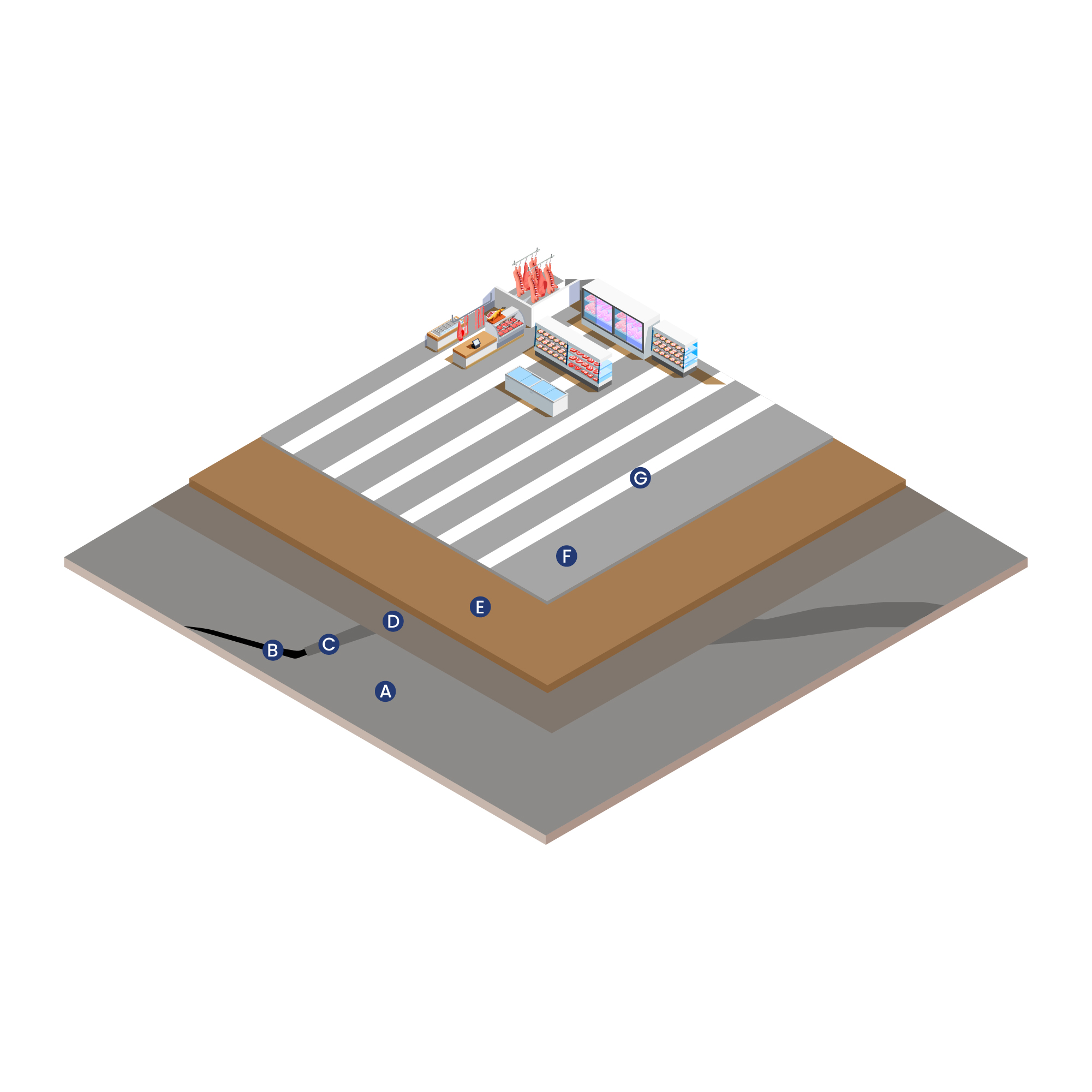
A Cementitious Surface: (Concrete slab or screed)
B Cracks and surface damage
C Crack Filler and Repairing Materials
D Ressi EPO Primer LV
E Ressi EPO Mid Coat S – GP
F Ressi EPO Floor Plus / Ressi EPO Floor Plus Econo
G Ressi EPO Gloss Might / Ressi EPO Roll Coat (Marking If needed)