
EPOXY FLOORING SYSTEM FOR – STATIC DISSIPATIVE / ANTI-STATIC APPLICATIONS
Introduction
Static electricity, when uncontrolled, can lead to electronic component damage, data loss, or even ignition hazards in sensitive environments.
In facilities where electrostatic discharge (ESD) is a risk, it is essential to use a flooring system capable of dissipating static charge in a controlled and safe manner.
The Epoxy Flooring System for Static Dissipative / Anti-Static Applications by Ressichem is a specially formulated conductive epoxy coating system that prevents static buildup and safely channels electrical charges through the floor to a grounding point. This ensures operational safety, equipment protection, and compliance with industrial ESD control standards.
Recommended Use Cases
- Electronic assembly and testing facilities
- IT server rooms and data centers
- Telecommunications and control rooms
- Defense and aerospace electronic zones
- Pharmaceutical and precision instrument laboratories
- Powder coating and paint-mixing facilities
Step-Wise System Description
Step 1: Surface Preparation
Proper substrate evaluation and preparation are essential to ensure conductivity continuity and coating adhesion.
- All necessary surface repairs, including crack filling or substrate restoration, must be completed prior to the application of any epoxy flooring materials.
- The concrete strength requirement must be determined by the consultant according to the operational load conditions.
- Check substrate integrity using both destructive (core samples) and non-destructive (Schmidt Hammer) testing methods.
- For major repairs (≥12 mm), use Ressi NSG 710, a high-strength, non-shrink cementitious repair mortar.
- For minor imperfections and leveling, blend Ressi EPO Primer LV with washed, graded, and completely dried (zero moisture content) silica sand to create a high-density repair mortar.
- Mechanically prepare the substrate via shot blasting or diamond grinding to achieve a clean, oil-free, and dust-free surface.
- For older or used floors, ensure complete removal of oil or grease penetration before coating.
Step 2: Application of Ressi SLS Primer – 1 and Ressi SLS 610 (If Required)
Where leveling is needed before epoxy installation, apply Ressi SLS Primer – 1, a latex-based bonding primer, followed by Ressi SLS 610, a self-leveling cementitious floor screed to correct floor irregularities and achieve a uniform surface.
Allow at least 7–14 days for the screed to release moisture, depending on ambient temperature and humidity, before proceeding with the epoxy application. Ensure that the moisture level is below 5% using a concrete moisture meter.
Step 3: Application of Ressi EPO Primer LV
- Apply Ressi EPO Primer LV, a low-viscosity, solvent-free epoxy primer designed to penetrate and seal the substrate.
- Mix resin and hardener components as per datasheet ratios.
- Apply using a trowel or epoxy squeegee to achieve full coverage.
- Allow curing before the next layer application.
Step 4: Application of Ressi EPO Anti-Static
- Apply Ressi EPO Anti-Static, a conductive epoxy coating formulated to provide consistent static dissipation and electrical grounding.
- Apply at a minimum thickness of 500 microns using a notched trowel or epoxy squeegee.
- Integrate conductive copper tape networks connected to an approved grounding point.
- An optional clear epoxy sealer may be applied if it does not interfere with static performance.
- Refer to Ressichem Technical Datasheets (TDS) for all parameters.
System Advantages
- Static Control: Safely dissipates electrostatic charges to prevent component damage or ignition hazards.
- Durable Surface: Retains conductivity and finish even under moderate traffic.
- Chemical Resistance: Resists cleaning solvents, oils, and maintenance agents.
- Seamless & Hygienic: Ideal for clean, dust-free environments.
- Long-Term Stability: Maintains performance over extended use.
- Customizable Finish: Available in matte or semi-gloss as required.
Maintenance Guidelines
- Regularly clean with neutral pH cleaners to avoid conductive layer degradation.
- Avoid applying wax or sealers unless compatibility is confirmed.
- Check floor performance periodically to confirm system stability.
- Periodic maintenance should include re-coating whenever required.
- Ensure that grounding points remain connected and functional.
System Summary Table
| Parameter | Description |
|---|---|
| System Name | Epoxy Flooring System for – Static Dissipative / Anti-Static Applications |
| Area Type | Specialized / High-Performance – Static-Controlled Environments |
| Traffic Exposure | Light to Medium |
| Primary Requirements | Controlled Static Dissipation |
| Primer (Optional) | Ressi SLS Primer – 1 (for SLS systems) |
| Leveling Layer (Optional) | Ressi SLS 610 (if required) |
| Epoxy Primer | Ressi EPO Primer LV |
| Conductive Layer | Ressi EPO Anti-Static (≥ 500 microns) |
| Silica Used | Washed, graded, and completely dried (zero moisture content) silica sand |
| Application Method | High-Build Trowel or Epoxy Squeegee |
| Finish Type | Smooth, Matte / Semi-Gloss Conductive Finish |
| Curing Time Before Use | 48–72 Hours (Light Use) / 7 Days (Full Cure) |
| Key Benefits | Static Control, Durability, Seamless Surface, Safety Compliance |
Conclusion
The Epoxy Flooring System for Static Dissipative / Anti-Static Applications ensures reliable electrostatic control, equipment protection, and safety in environments where electrical discharge poses operational risks.
The sequence — Surface Preparation, Ressi SLS Primer – 1, Ressi SLS 610 (if needed), Ressi EPO Primer LV, Ressi EPO Anti-Static — provides a high-performance, conductive, and durable flooring solution suited for electronics, pharmaceutical, and industrial facilities.
System Summary
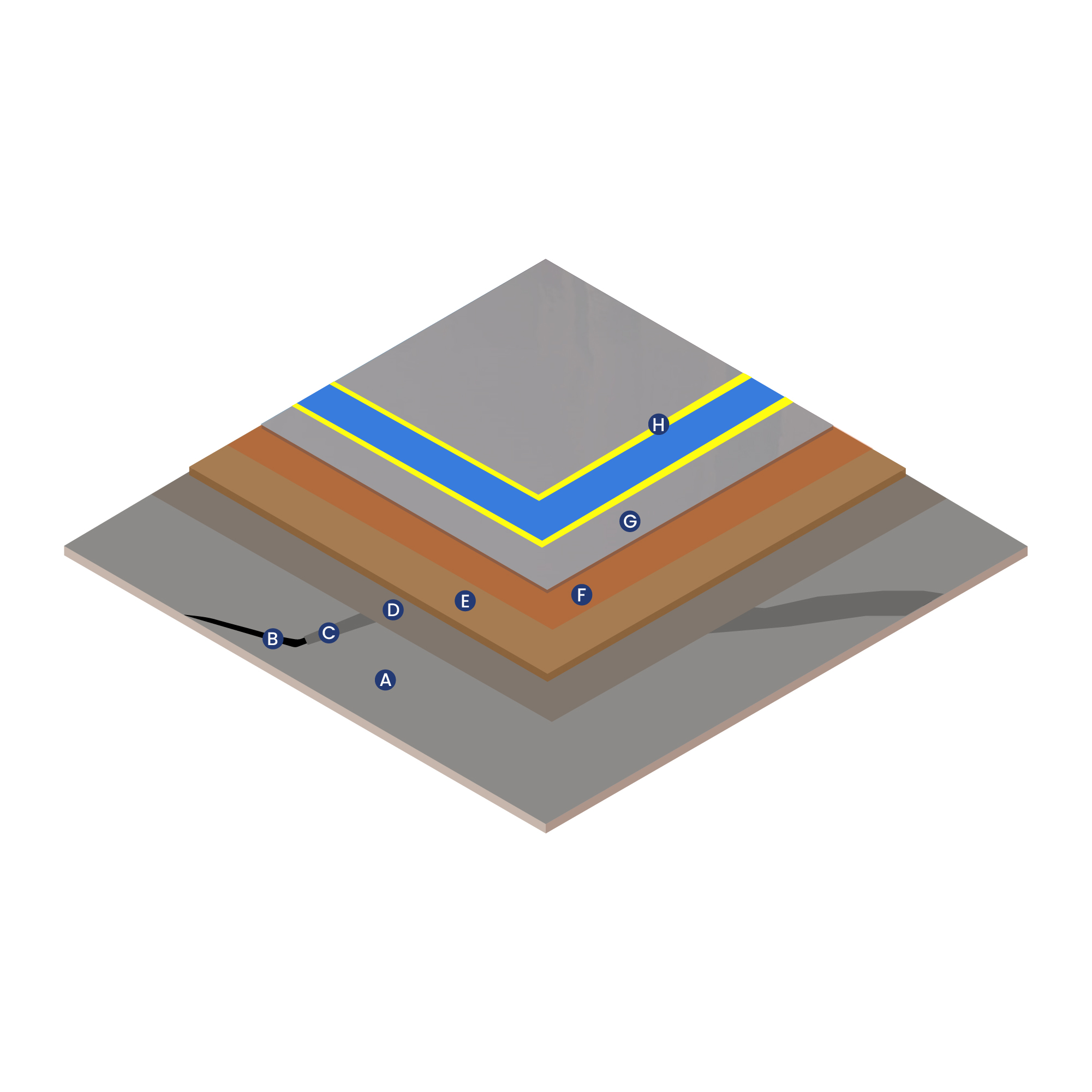
A Cementitious Surface: (Concrete slab or screed)
B Cracks and surface damage
C Crack Filler and Repairing Materials
D Ressi SLS Primer – 1
E Ressi SLS 610
F Ressi EPO Primer LV
G Ressi EPO Anti-Static
H Ressi EPO Anti-Static (Marking)