
A 1kg epoxy resin purchase is a practical starting point for technical buyers testing a formulation, producing a small batch, or assessing a resin before moving to larger volumes. The correct buying decision depends on the resin chemistry, the separately selected hardener, the required viscosity, cure behaviour and end-use performance not only the initial per-kg price.
Ressichem supplies industrial epoxy resins from 1kg upward for manufacturers, formulators, contractors, coating producers and adhesive producers. These are raw resin products for professional applications, rather than pre-bundled resin-art or casting kits.
What does a 1kg epoxy resin purchase include?
A Ressichem 1kg epoxy resin pack contains resin only; the matching hardener is selected separately according to the application. This gives buyers control over cure time, chemical resistance and final system performance instead of locking them into one pre-set resin-to-hardener kit ratio.
A resin by itself does not become a cured epoxy system until it is paired with a compatible hardener. Ressichem supplies hardeners across multiple categories: Polyamides, Amidoamines, Cycloaliphatic Amines and Phenalkamines.
This approach is useful when a buyer needs to test a particular system rather than purchase a general-purpose hobby product. A coating producer may require different cure behaviour from a flooring contractor, adhesive manufacturer or composite fabricator, even when each starts with a 1kg resin quantity.
Ressichem’s technical team can help select the appropriate resin and hardener combination for the required use. The company has manufactured construction and industrial chemicals since 1999, with an in-house lab, qualified engineers and chemists, globally sourced raw materials, and onsite technical support.
Which Ressichem 1kg epoxy resin is right for your project?
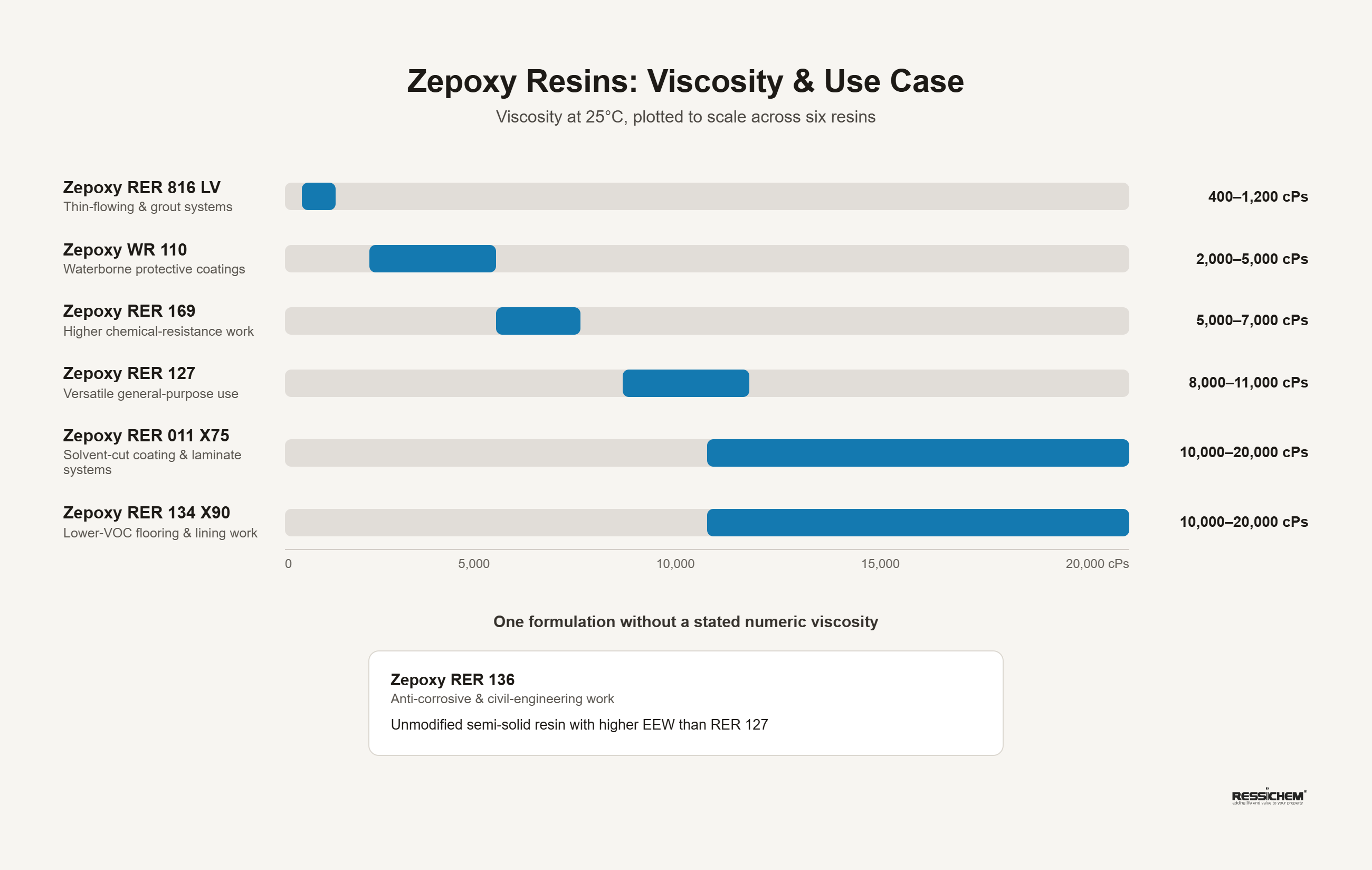
The right 1kg epoxy resin depends on what you are making and how the material must perform after curing. This guide compares seven selected resin options with different viscosity, formulation type, VOC profile and use-case strengths, so buyers can select a resin for the job rather than force every application into one generic product.
A few technical terms are useful before comparing options:
Viscosity means how freely a resin flows. Lower-viscosity material is thinner and easier to penetrate, mix or apply in systems such as grouts and potting compounds; higher-viscosity material is thicker.
VOC means volatile organic compounds. A low-VOC or zero-VOC option can matter where environmental requirements, odour control or application conditions are important.
EEW means epoxy equivalent weight. It is a technical property used when formulating and selecting the correct hardener ratio; it should not be guessed by the buyer.
Use case group | Resin | Resin type and key property | Best-fit applications |
Versatile general-purpose industrial applications | Zepoxy RER 127 | Unmodified bisphenol-A epoxy resin; medium viscosity of 8,000–11,000 cPs | Coatings, adhesives, construction, automotive, marine, casting/molding and composites |
Anti-corrosive and civil-engineering work | Zepoxy RER 136 | Unmodified semi-solid resin with higher EEW than RER 127 | Anti-corrosive and marine coatings, civil engineering and coal tar epoxy adhesives |
Solvent-cut coating, paint and laminate systems | Zepoxy RER 011 X75 | Solvent cut in xylene; high EEW | Anti-corrosive coatings, marine and industrial paints, adhesives and laminates |
Lower-VOC solvent-cut flooring and lining work | Zepoxy RER 134 X90 | Solvent cut in xylene; low-VOC alternative to RER 011 X75 | Tank lining, coal tar-based coatings and flooring |
Thin-flowing formulations and grout systems | Zepoxy RER 816 LV | Reactive diluent modified; very low viscosity of 400–1,200 cPs; low odour | Flooring compounds, potting compounds, adhesives, mortars and grouts, laminating binders |
Higher chemical-resistance applications | Zepoxy RER 169 | Special liquid bisphenol-F resin; low viscosity of 5,000–7,000 cPs; better chemical resistance than bisphenol-A resins | Flooring, grouts, electrical castings and composites |
Waterborne protective coating systems | Zepoxy WR 110 | Waterborne resin; zero VOC; 60% solids in water | Fibre sizing, protective coatings for steel and concrete, and adhesives |
Choose Zepoxy RER 127 for the broadest range of applications
Zepoxy RER 127 is the most versatile option among the seven listed resins because it supports a wide range of coating, adhesive, construction, automotive, marine, casting/molding and composite applications. It is an unmodified bisphenol-A epoxy resin with medium viscosity of 8,000–11,000 cPs.
A buyer evaluating an industrial epoxy resin supplier in Pakistan for varied small-batch work may start with RER 127 when the project does not require a clearly specialised low-viscosity, waterborne or higher-chemical-resistance resin. The hardener must still be selected separately for the intended end use.
Choose RER 136, RER 011 X75 or RER 134 X90 for coating-focused systems
Zepoxy RER 136, RER 011 X75 and RER 134 X90 are suited to buyers focused on anti-corrosive coatings, marine work, industrial paints, tank lining, flooring or coal tar-based systems. The correct choice depends on whether the system needs an unmodified semi-solid resin, a solvent-cut resin, or a lower-VOC alternative.
RER 136 supports anti-corrosive and marine coatings, civil engineering and coal tar epoxy adhesives. RER 011 X75 is solvent cut in xylene and suited to anti-corrosive coatings, marine and industrial paints, adhesives and laminates.
RER 134 X90 is also solvent cut in xylene but is a low-VOC alternative to RER 011 X75. It is suited to tank lining, coal tar-based coatings and flooring applications.
Choose RER 816 LV when low viscosity matters
Zepoxy RER 816 LV is designed for applications that benefit from a very low-viscosity, low-odour resin. Its 400–1,200 cPs viscosity makes it relevant for flooring compounds, potting compounds, mortars, grouts, laminating binders and suitable adhesive systems.
Very low viscosity can be valuable where the resin must flow into a formulation, wet a substrate or be processed in a thinner system. The final performance still depends on using the suitable hardener category and formulation design.
Choose RER 169 for stronger chemical-resistance needs
Zepoxy RER 169 is a low-viscosity bisphenol-F resin that offers better chemical resistance than bisphenol-A resins. It is suited to flooring, grouts, electrical castings and composites where that performance requirement matters.
Its viscosity range is 5,000–7,000 cPs, making it lower in viscosity than RER 127 while serving a different performance purpose. Buyers should identify the actual chemical exposure and service conditions before selecting a resin-hardener system.
Choose WR 110 for waterborne, zero-VOC systems
Zepoxy WR 110 is a waterborne epoxy resin with zero VOC and 60% solids in water. It is suited to fibre sizing, protective coatings for steel and concrete, and adhesive applications.
This option is relevant where a waterborne formulation or zero-VOC profile is required. Buyers should confirm the wider system requirements with Ressichem’s technical team before choosing the compatible hardener and formulation route.
Why the resin-to-hardener ratio is not fixed
The resin-to-hardener ratio is not fixed because Ressichem’s 1kg products are resin-only and can be paired with different hardener categories. The correct ratio depends on the selected resin, the selected hardener and the application’s required cure time, resistance and performance.
Polyamides, Amidoamines, Cycloaliphatic Amines and Phenalkamines do not serve as interchangeable add-ons. Each category can support different system requirements, so a buyer should not apply a ratio from a pre-bundled hobby kit to an industrial resin system.
For example, coating, flooring, adhesive, marine, composite and electrical casting applications may need different cure characteristics. The resin’s EEW is one of the technical properties used to determine the suitable formulation ratio.
Ressichem can supply both sides of the epoxy system: resin packs from 1kg to larger industrial quantities and compatible hardener categories. This enables technical buyers to build a system around the actual application rather than accept a one-ratio package.
How much area does 1kg of epoxy resin cover?
One kilogram of epoxy resin does not have a single fixed coverage area because yield changes with resin type, hardener selection, mixed-system density, substrate profile and required film thickness. A thin epoxy coating is often broadly estimated at around 0.5–1.0 square metres per kg at approximately 1 mm system thickness, but this is only a general industry reference not a product-specific coverage claim.
Coverage decreases when the specified film is thicker, the substrate is rough, or the application involves mortar, grout, filler or absorption into an uneven surface. A very low-viscosity resin used in a formulation also cannot be assumed to cover the same area as a standard coating system.
For procurement and production planning, specify the required dry film thickness, application method and hardener first. Ressichem’s technical team can then help determine the appropriate resin system and estimate material requirements for the stated application.
Factors that affect epoxy resin price in Pakistan
Epoxy resin price per kg in Pakistan depends on the resin chemistry, selected hardener, pack size and movement in raw material and import costs. A technically accurate price comparison must compare like-for-like systems rather than treating every epoxy resin as the same product.
The resin type is a primary cost driver. An unmodified bisphenol-A resin, bisphenol-F resin, solvent-cut resin, reactive-diluent-modified resin and waterborne resin each have different formulation characteristics and intended uses.
Hardener choice also affects the complete system cost because a resin-only pack needs a separately chosen curing component. The selected Polyamide, Amidoamine, Cycloaliphatic Amine or Phenalkamine must match the performance requirement rather than simply be the lowest-cost option.
Pack size affects purchasing economics as well. A 1kg quantity is useful for evaluation, small production runs and trial formulations, while larger quantities can be more suitable once the resin-hardener combination has been validated.
Epoxy resin pack sizes and bulk pricing
Ressichem epoxy resins are available from 1kg and can scale to 5kg, 10kg, 30kg and 200–230kg quantities. Per-kg cost typically decreases at larger volumes, but the actual quote depends on the selected resin, hardener requirement, quantity and current raw material conditions.
A 1kg epoxy resin pack is appropriate when a technical buyer needs to test viscosity, handling, cure response or finished performance before committing to bulk quantities. It also allows smaller manufacturers and contractors to source a resin for limited production or project requirements.
A 20-litre epoxy resin enquiry should not be priced as a generic commodity request. The buyer needs to identify the resin grade, whether the request is resin-only or a complete resin-plus-hardener system, and the intended formulation or application.
Do not choose a large pack only because it appears cheaper per kilogram. A larger purchase only provides value if the resin, hardener and required performance profile are correct for the project.
How to choose the right epoxy resin and hardener
The right epoxy resin and hardener combination should be chosen from the required application, flow behaviour, environmental requirements, chemical or heat exposure and required cure time. A short technical checklist prevents buyers from purchasing a resin that is workable in the container but unsuitable after curing.
Use the following questions before requesting a quote:
What is the application? State whether the system is for coating, adhesive, flooring, grout, mortar, tank lining, composite work, electrical casting, fibre sizing or another use.
What viscosity is needed? A thin-flowing system may require a low-viscosity resin such as RER 816 LV or RER 169, while other applications may suit RER 127 or another grade.
Are VOC or environmental requirements important? A waterborne, zero-VOC option such as WR 110 may be relevant for suitable protective coating or adhesive systems.
What chemical or service resistance is needed? Where stronger chemical resistance is a priority, RER 169 may be the better starting point because it is a bisphenol-F resin with better chemical resistance than bisphenol-A resins.
How quickly must the system cure? Cure time is linked to the selected hardener and application conditions, so it should be confirmed before procurement.
What quantity is needed after testing? Start at 1kg where appropriate, then move to 5kg, 10kg, 30kg or 200–230kg when the system has been approved.
Providing these details to the technical team enables a more useful recommendation than asking only for “epoxy resin without hardener.” It also helps ensure the requested price reflects the actual industrial epoxy system required.
Epoxy resin ka price kitna hai / Epoxy resin kahan se milega Pakistan mein?
Epoxy resin price depends on the grade, selected hardener, quantity and current material costs, so a meaningful quote requires the intended application and required pack size. In Pakistan, technical buyers can request resin-only packs from 1kg and obtain guidance on selecting the right matching hardener.
A buyer should mention whether the resin is required for coatings, adhesives, flooring, grouts, marine use, composites, electrical casting or another industrial purpose. This helps distinguish a suitable technical epoxy system from a generic pre-bundled retail kit.
Frequently asked questions
How much does 1kg of epoxy resin cost?
The cost of 1kg of epoxy resin depends on the selected resin grade, the separately chosen hardener, the required performance and current raw material conditions. Ressichem supplies multiple resin types from 1kg, so request a quote with your application and required resin-hardener system rather than relying on a generic price.
A 1kg order may be used for testing, small production runs or a limited technical project. The quote should state whether you need resin only or a complete resin-plus-hardener system.
How much area can 1kg of epoxy resin cover?
One kilogram of epoxy resin can cover different areas depending on the resin, hardener, mixed-system density, substrate condition and film thickness. A thin epoxy coating is often broadly estimated at around 0.5–1.0 square metres per kg at about 1 mm thickness, but this is a general reference rather than a product-specific yield.
Thicker films, rough surfaces, grout systems and filled formulations will change material consumption. Confirm the required thickness and application method before calculating material quantity.
What is the price of 20 liters of epoxy resin in Pakistan?
The price of 20 litres of epoxy resin in Pakistan depends on the resin grade, hardener requirement, exact quantity basis and current raw material costs. Request a quote after confirming whether you need a resin-only pack or a complete industrial resin-plus-hardener system for coatings, flooring, adhesives, grouts or another application.
Different formulations such as bisphenol-A, bisphenol-F, solvent-cut, reactive-diluent-modified and waterborne resins should not be compared as if they have identical performance. The correct resin selection comes before an accurate price quotation.
How much does epoxy resin cost per kg?
Epoxy resin cost per kg varies with resin type, hardener type, pack size and current raw material or import cost movement. Larger purchase volumes can reduce the per-kg cost, but the most useful quote is based on the precise Zepoxy resin grade and compatible hardener needed for the application.
Ressichem offers quantities from 1kg through 5kg, 10kg, 30kg and 200–230kg. Request a quote after sharing your use case, required quantity, viscosity needs and performance requirements.
Request a Quote: Available from 1kg, with complete resin + hardener systems available. Ressichem’s technical team can help pair the right combination for your project.