
Lime plaster is a breathable, flexible cement-free wall finish and repair material that is especially valuable for historic masonry and moisture-sensitive walls. It is not universally better than cement plaster, but it can be the more compatible choice where an older wall was originally built with lime mortar.
What is lime plaster?
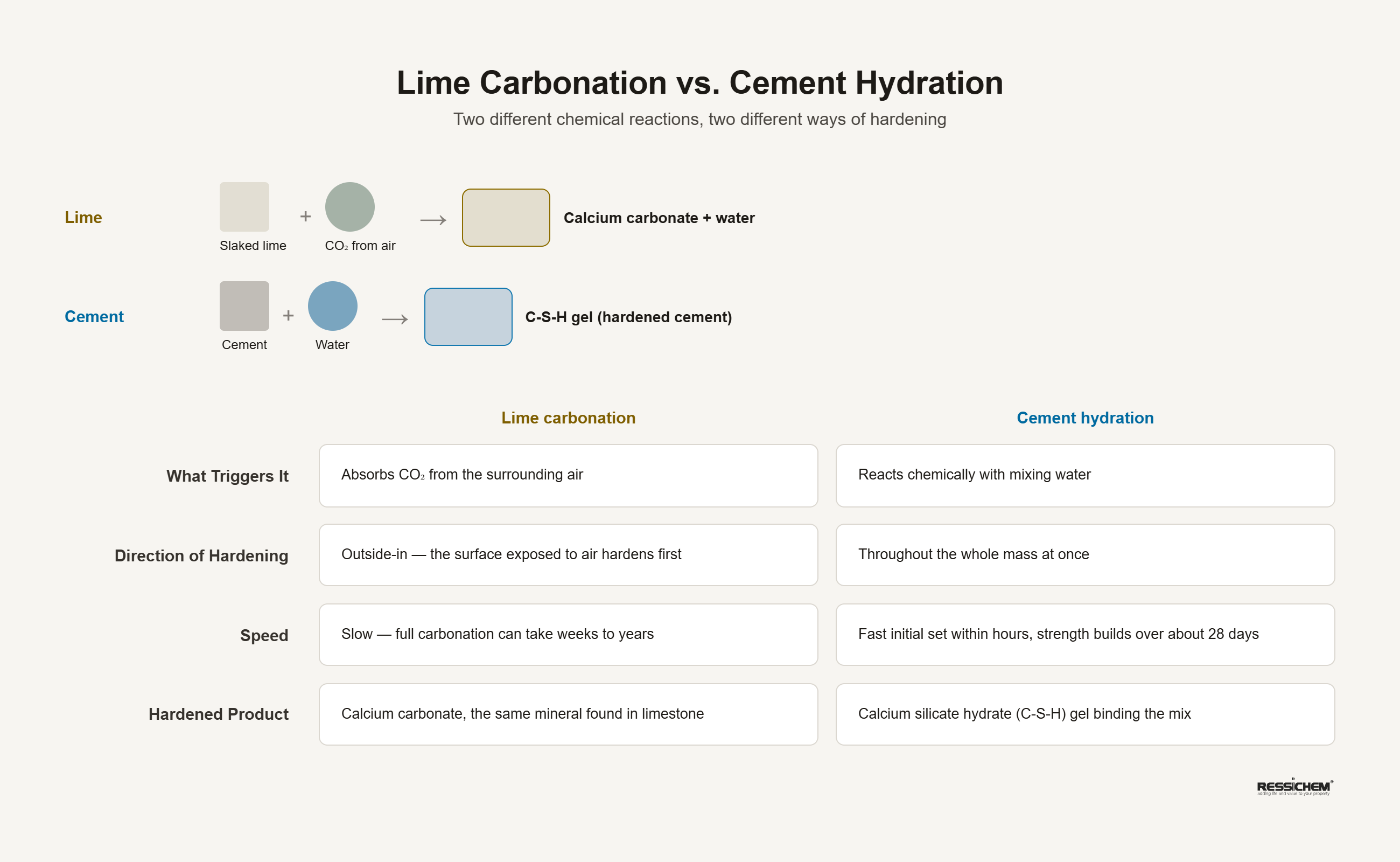
Lime plaster is a plaster made with lime-based binder and aggregate that hardens mainly through carbonation: the lime reacts with carbon dioxide in the air over time. Cement plaster hardens through hydration, a different chemical process that occurs when cement reacts with water.
This difference affects how the materials behave after application. Traditional lime plaster is generally more vapour-permeable and more accommodating of minor movement, while cement plaster is typically harder and stronger in compression.
Lime plaster can be used as a decorative wall finish, a repair mortar, a render, or part of a heritage restoration system. It should be selected according to the building fabric, exposure conditions and desired finish rather than chosen purely as a visual alternative to cement.
Why did we stop using lime plaster?
Lime plaster did not stop working; Portland cement and later gypsum-board systems largely displaced it because they offered faster, more standardised construction workflows. Cement rose in mainstream construction from the 19th century onward, while gypsum board added convenience and speed during the 20th century.
Modern construction often values quick turnaround, predictable strength and readily available standard materials. Traditional lime work can need more specialised material knowledge, careful application and a slower carbonation process, particularly in heritage-quality work.
That change in mainstream practice does not make lime irrelevant. It means lime is now often selected for specialist situations: historic buildings, breathable wall finishes, conservation work and projects where material compatibility matters more than speed alone.
Types of lime used in Pakistan
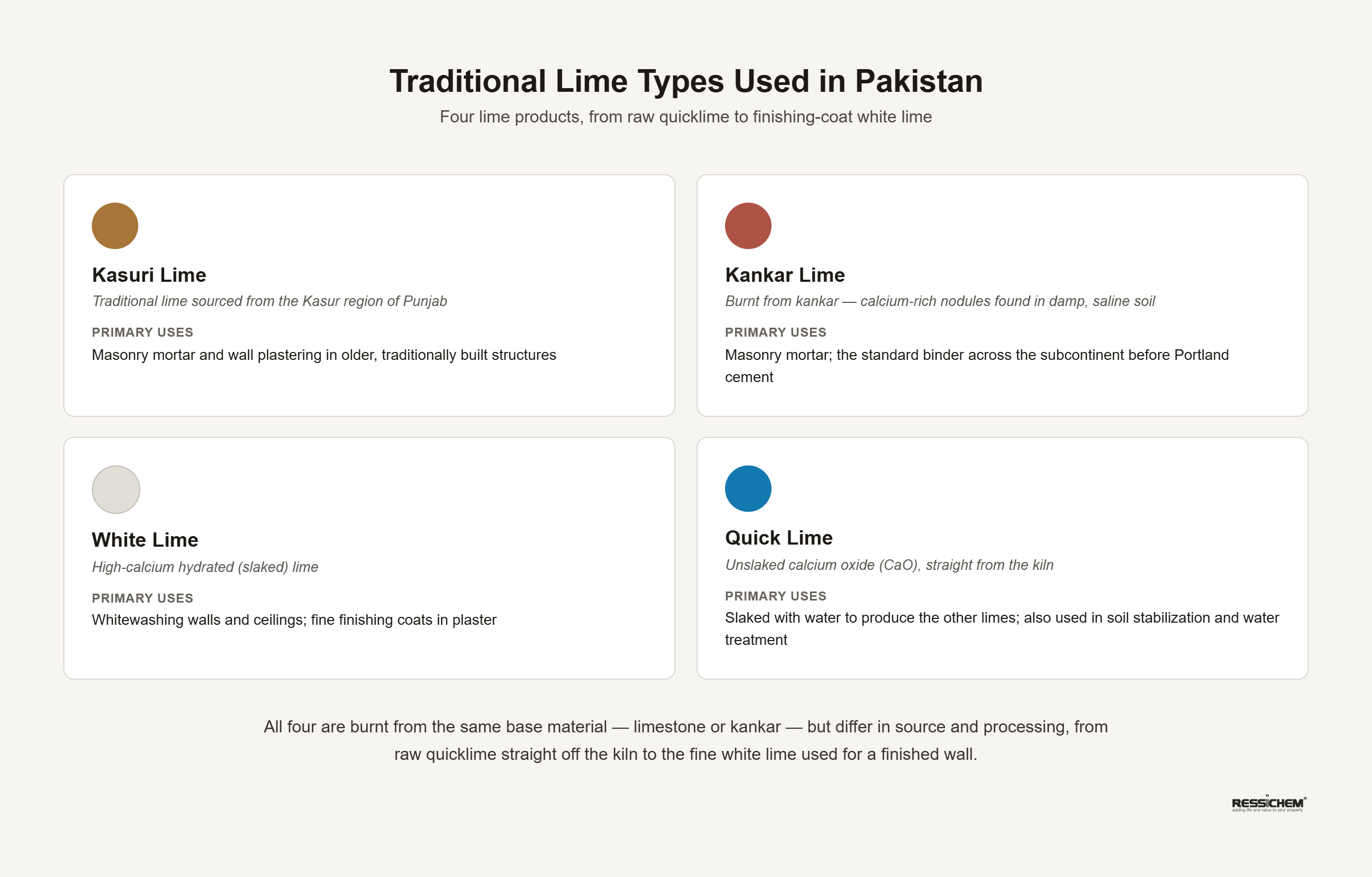
Pakistan has several traditional lime types used in mortar and plaster work, each with a different origin and practical role. The correct lime depends on whether the work involves decorative finishing, traditional masonry repair, general plastering or a purpose-made premixed repair product.
Kasuri Lime
Kasuri Lime is quarried from the Kasur region and is commonly associated with fine and decorative plasterwork. It is valued in traditional work where finish quality and craftsmanship are important.
This type of lime is often discussed in the context of heritage and decorative applications. Its selection and preparation should reflect the existing building material and the intended appearance of the finish.
Kankar Lime
Kankar Lime is obtained from calcareous nodules and is a primary traditional mortar grade in the region. It has been used in historic masonry and plaster systems where lime-based construction was the original method.
For conservation work, a lime repair mortar should be compatible with the original masonry rather than simply harder than it. Kankar lime’s traditional relevance makes it important to understand when assessing historic mortar systems in Pakistan.
White Lime
White Lime is a finer lime grade commonly associated with finishing work. It is used where a smoother, more refined plaster appearance is required.
A white lime finish may be selected for decorative interiors or restored surfaces where visual quality is central to the project. The final result still depends on mix proportions, substrate preparation and the skill of the applicator.
Quick Lime
Quick Lime must be slaked before it can be used safely in a traditional lime plaster or mortar system. Slaking means carefully reacting the quick lime with water to produce a usable lime material.
This preparation stage is one reason traditional lime work can require experienced handling and longer planning. It should not be treated as a casual substitution for ordinary cement in a site mix.
A manufactured alternative such as Ressi LimeOmight 8000 avoids the slaking stage entirely. It is supplied as a ready-to-use premixed lime-based repair mortar and plaster for suitable applications.
Lime plaster vs. cement plaster
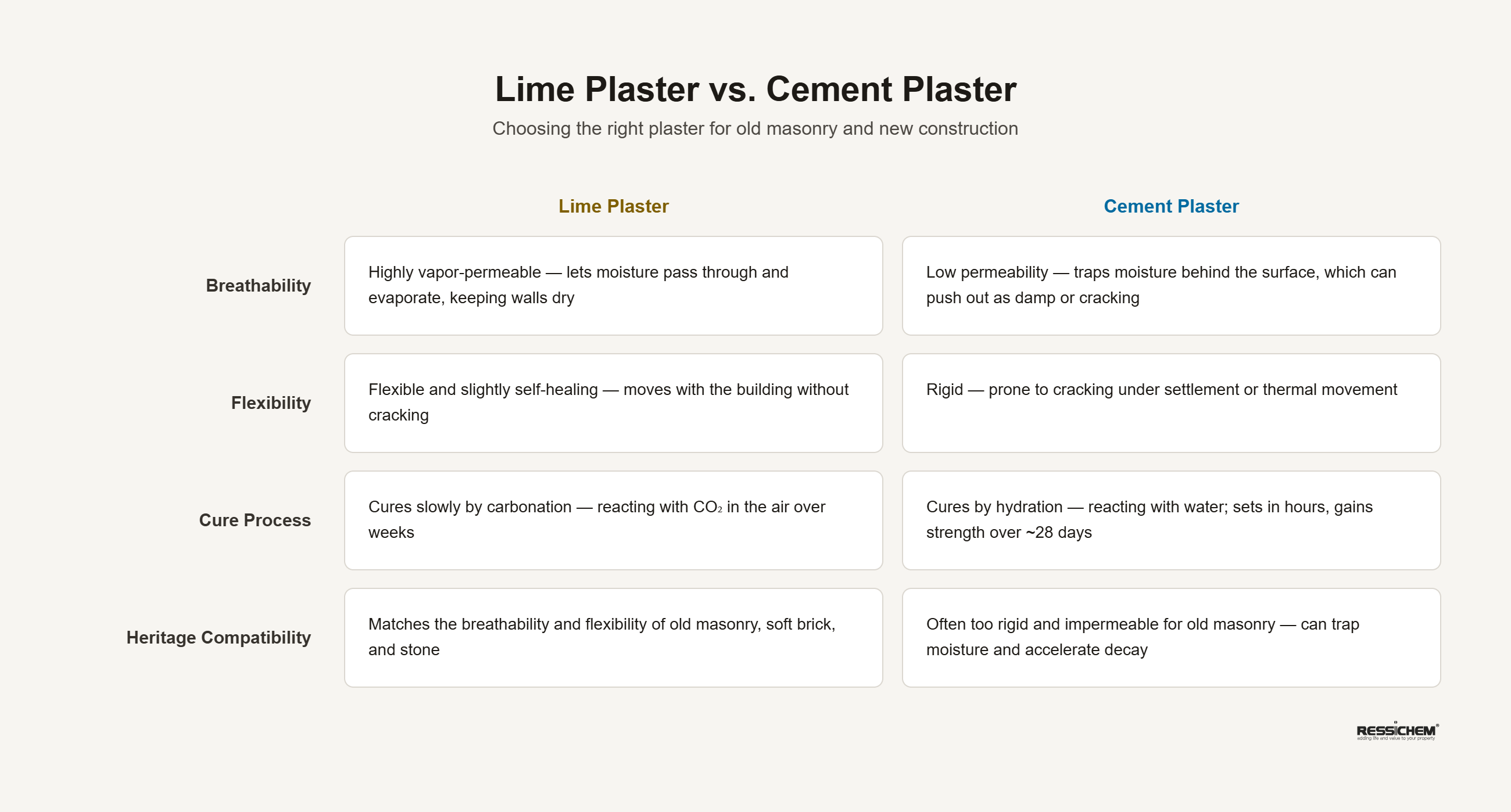
Lime plaster and cement plaster differ in breathability, flexibility, curing behaviour and suitability for historic masonry. Lime is often the more compatible material for old lime-built walls, while cement may be more appropriate where higher compressive strength and modern construction performance are the priority.
Consideration | Lime plaster | Cement plaster |
Hardening process | Traditional lime cures through slow carbonation with carbon dioxide | Cement hardens through hydration with water |
Moisture behaviour | More breathable and vapour-permeable | Less breathable; may trap moisture in old masonry |
Flexibility | Better able to accommodate minor movement | More rigid and generally harder |
Historic masonry compatibility | Often suitable for lime-built heritage structures | Can be chemically incompatible with original lime mortar |
Strength profile | Lower raw compressive strength | Typically higher compressive strength |
Construction workflow | Traditional systems may require specialist preparation and longer curing | Widely used in fast, standard modern construction |
Traditional lime plaster can cure through carbonation over weeks to months. This slower process is part of why conventional lime work needs more planning than cement plastering.
Ressi LimeOmight 8000 differs from traditional slaked lime plaster in its site workflow. It requires no curing, and its technical data states that it shows constant strength gains even after 28 days.
Breathability does not mean a wall can ignore water-entry problems. A breathable wall finish supports moisture vapour movement, but active leaks, defective drainage, failed roofs or rising moisture still need to be assessed and resolved through the appropriate repair approach.
What is lime plaster good for?
Lime plaster is good for heritage restoration, breathable wall finishes, humidity-regulating interiors and projects seeking a lower-rigidity alternative to cement plaster. It is especially relevant where old walls were originally constructed with lime mortar and need a compatible repair material.
In a suitable wall system, lime plaster can allow moisture vapour to move more freely than a dense cement finish. This is useful for old masonry that needs to manage moisture without trapping it behind a hard, incompatible render.
Lime can also suit eco-conscious construction and design-led finishes. The final choice should still account for exposure, substrate, maintenance expectations and the structural performance required from the plaster.
Why lime plaster matters for heritage restoration in Pakistan
Lime plaster matters in heritage restoration because many historic Pakistani structures were built with lime mortar and lime-based finishes. Replacing those materials with dense modern cement plaster can trap moisture and accelerate deterioration in the original fabric.
Mughal, Sikh and Sultanate-era structures across Pakistan used lime-based construction materials. Examples include Lahore’s Shahdara Tombs, Lahore Fort and Wazir Khan Mosque, where conservation work requires careful attention to the compatibility of repair materials.
Modern cement plaster can be chemically incompatible with old lime mortar. A hard, less-breathable repair layer may change how the original wall handles moisture, causing deterioration to continue behind the newer surface.
Heritage restoration should therefore begin with an understanding of the original wall system, not just the visible damage. The goal is not to make a historic wall behave like new cement construction; it is to repair it with a material that works appropriately with the existing masonry.
This is the gap that Ressi LimeOmight 8000 is designed to address: a ready-to-use, premixed lime-based repair mortar and plaster purpose-built for old heritage buildings originally constructed with lime mortar.
Is lime plaster expensive?
Lime plaster can be cheaper or more expensive than cement plaster depending on the type of lime work being compared. Informal mud-and-lime finishes in rural construction can be notably cheaper than cement, while specialist heritage-grade lime restoration commonly costs more because it may involve quarried lime, artisan labour and lengthy traditional curing.
A simple statement that lime plaster is always expensive or always affordable is misleading. Kasuri or Kankar lime sourcing, traditional slaking, skilled applicators, decorative requirements, wall preparation and long curing periods can all increase the cost of heritage-quality lime work.
Ressi LimeOmight 8000 is a manufactured, ready-to-use premix that reduces some of the labour and sourcing complexity associated with traditional heritage-grade lime work. It does not remove the need for proper assessment or skilled application where the project is a sensitive conservation repair.
Exact lime plaster price depends on the substrate, project scale, selected finish, thickness, labour requirements and whether the work is informal rural construction, decorative plastering or specialist restoration. Request a project-specific quote rather than relying on a generic market figure.
Substrate, moisture exposure and finish considerations
Lime plaster should be chosen according to the wall substrate, moisture exposure and finish requirements, because a suitable lime repair can fail if applied over an unsuitable or unstable background. A good decorative finish requires a sound, compatible surface and the correct layer build-up.
Ressi LimeOmight 8000 is intended as a lime-based repair mortar and plaster for old heritage buildings originally built with lime mortar. It can provide a good decorative finish and can be machine-sprayed where that application method suits the project.
The product can be applied in multiple layers at any thickness. This makes it practical for repair work where the existing wall needs gradual build-up rather than a single heavy, uncontrolled application.
Moisture conditions should be assessed before plastering. Lime plaster may be appropriate for walls that need breathability, but it should not be expected to solve an unresolved source of water ingress, damaged roof detailing or other active moisture problem.
Ressi LimeOmight 8000 has a maximum aggregate size of 2mm and an approximate yield of 0.65 m³ per tonne. Its wet mix life is less than 45 minutes at 20°C, so site teams should plan mixing and application quantities accordingly.
When lime plaster is not the right choice
Lime plaster is not the right choice for every project because it has lower raw compressive strength than cement and traditional lime work often requires specialised application skills. Projects that require the performance profile of a high-strength cementitious finish may need another system.
It is also not sensible to use lime plaster simply because it is fashionable or associated with heritage. The existing substrate, structural condition, exposure environment and intended use must support the material choice.
Traditional lime work requires care in choosing the lime type, preparing the material and allowing for its curing behaviour. If a project cannot accommodate those requirements, a ready-to-use premix or a different compatible repair system may be more practical.
Lime plaster should not be used to cover unresolved structural cracks, severe substrate instability or an ongoing water-entry defect without correcting the underlying issue. A finish can only perform as well as the prepared wall beneath it.
Ressi LimeOmight 8000: Ressichem’s solution
Ressi LimeOmight 8000 is a ready-to-use, premixed lime-based repair mortar and plaster designed for old heritage buildings originally constructed with lime mortar. It provides a simplified alternative to traditional slaked-lime preparation while retaining a lime-based approach for compatible restoration work.
Ressi LimeOmight 8000 requires no curing and continues to gain strength after 28 days. Its confirmed 28-day compressive strength is 2 N/mm², and its flexural strength is 0.5 N/mm².
The product is machine-sprayable, suitable for application in multiple layers at any thickness, and supplied in 50kg bags. It has a shelf life of 6 months and is custom-made per project.
For applications exceeding 18mm in a single layer, Ressi SBR 5850 can be added at 1kg per 50kg bag to support early and higher strength.
For a suitable heritage repair or premixed lime plaster system, see Ressi LimeOmight 8000. For broader dry-mix options, explore the Ressichem premix plasters and dry-mix mortars category.
Lime plaster kya hota hai / Chuna plaster ke faide
Lime plaster, or chuna plaster, is a lime-based wall finish and repair material used for breathable, flexible and moisture-compatible cement-free plaster systems. It is particularly useful for old buildings built with lime mortar, decorative finishes and heritage restoration work.
Its benefits include improved vapour permeability and better compatibility with traditional lime masonry. It should not be treated as a direct replacement for cement plaster in every building, because material selection depends on the wall and project requirements.
Frequently asked questions
What is lime plaster?
Lime plaster is a lime-based mortar or wall finish that hardens primarily through carbonation, reacting with carbon dioxide in the air. It is used for breathable wall finishes, repairs and heritage restoration, particularly where the original building was constructed with lime mortar.
Traditional lime plaster differs from cement plaster because cement hardens through hydration. Lime is generally more flexible and vapour-permeable, while cement generally has higher compressive strength.
Why did we stop using lime plaster?
Lime plaster was displaced from mainstream construction because Portland cement and gypsum board offered faster, more standardised construction methods. Lime plaster did not become ineffective; it simply became less common as modern materials prioritised speed, predictable workflow and wider availability.
Lime remains relevant for heritage buildings, breathable finishes and compatible repair of lime-based masonry. Traditional lime application can require more specialised skill and longer curing than cement-based work.
Is lime plaster expensive?
Lime plaster cost varies widely by type and application. Rural mud-and-lime finishes can be cheaper than cement, while skilled heritage restoration using traditional lime, specialist labour and prolonged curing often costs more than equivalent cement plaster work.
Ready-to-use premixes such as Ressi LimeOmight 8000 can reduce some traditional sourcing and labour complexity. Request a project-specific quote because no single price accurately represents all lime plaster work.
What is lime plaster good for?
Lime plaster is good for heritage restoration, breathable wall finishes, humidity-conscious interiors and repair of old masonry originally built with lime mortar. It can be more compatible than cement plaster where preserving the original wall’s moisture behaviour is important.
Lime plaster is not a cure for active leaks or structural damage. It should be selected after considering the substrate, exposure conditions and the required level of strength and durability.