
SBR chemical is commonly added to cement-based mixes when a site needs stronger bonding, improved flexibility and better resistance to water penetration. It is used in repair mortars, screeds, renders, bonding coats and waterproofing slurries; it is not a ready-to-use mortar or a standalone waterproofing membrane.
What is SBR chemical?
SBR chemical is a synthetic polymer latex called Styrene Butadiene Rubber, supplied as a milky white liquid that is added to cement-based mixes. In construction, it improves the bonding, flexibility and water resistance of mortar, render, slurry or screed.
SBR is not normally applied as-is to perform a complete repair. It is mixed into a cement-based system so that the cementitious material gains better adhesion and lower porosity.
Contractors may hear it described as an SBR bonding agent, SBR admixture, styrene butadiene rubber latex, or an SBR waterproofing chemical. These terms refer to its role in modifying cement-based materials for improved performance.
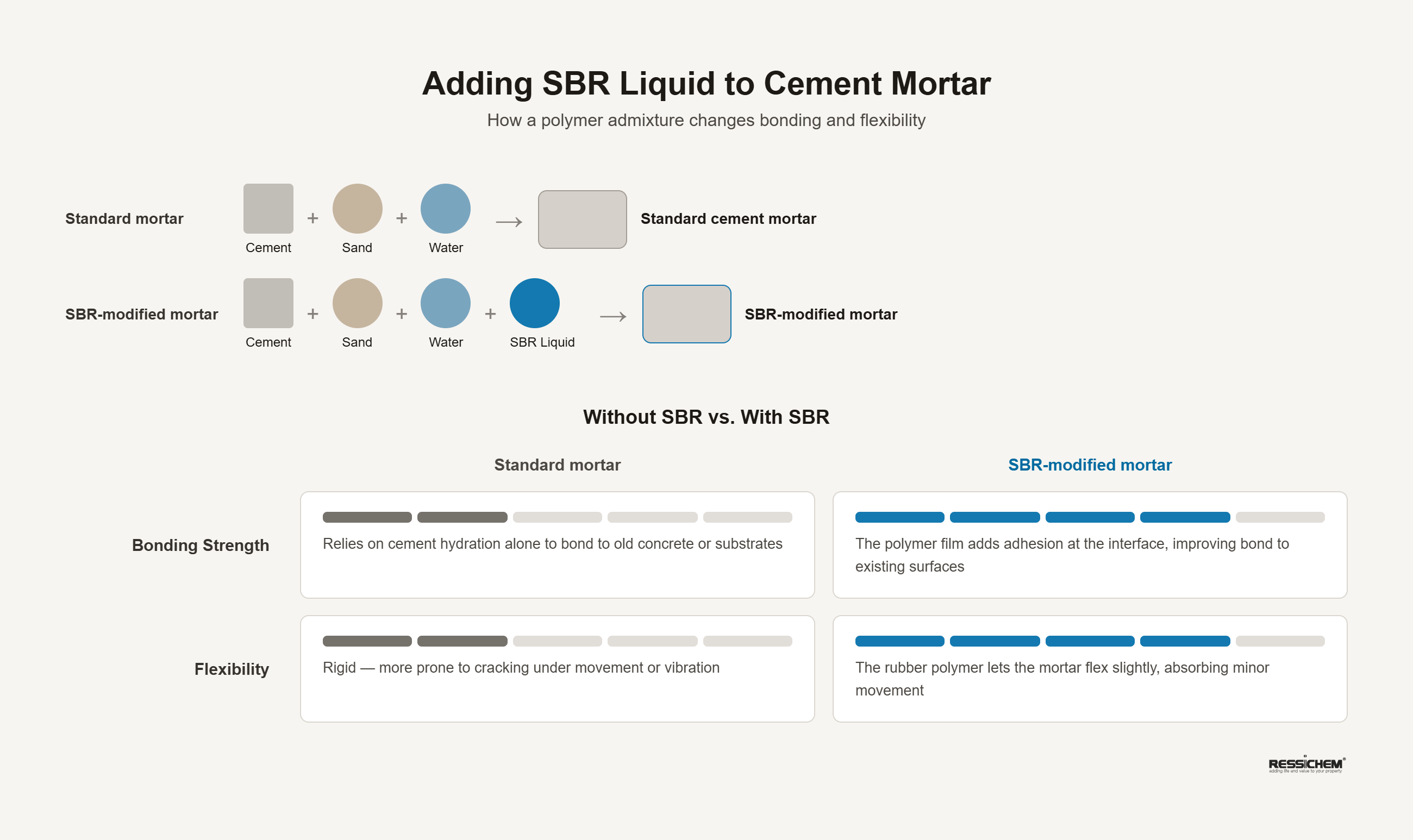
What does SBR actually do when added to a cement mix?
SBR improves the performance of cement mortar by increasing tensile and flexural strength, reducing porosity and reducing shrinkage. It is compatible with all cement types and helps create a more durable cement-based mix when correctly selected and dosed.
Tensile strength is the material’s ability to resist pulling forces, while flexural strength is its ability to resist bending stress without cracking. These properties matter in repair mortars, screeds and renders that may experience movement, impact or stress after curing.
Reducing porosity means there are fewer easy pathways for water and aggressive elements to enter the cement matrix. This helps improve resistance to moisture-related deterioration and can support prolonged corrosion protection in suitable cement-based repair or protective systems.
SBR also improves adhesion between a new cementitious layer and an existing concrete substrate. This is especially useful when applying repair mortar, a bonding coat, floor screed or render onto old concrete where ordinary cement mortar may not bond reliably.
Key uses of SBR chemical
SBR chemical is used to modify cement-based repair, bonding, rendering, screeding and waterproofing systems where stronger adhesion and improved water resistance are needed. The specific dosage and mix design should match the application because a bonding slurry, repair mortar and waterproofing slurry do not use SBR in exactly the same way.
Repair mortars
SBR is used in repair mortars to help the cement-based repair layer bond more effectively to existing concrete. It also supports improved strength, flexibility and reduced shrinkage in the repair mix.
Repair mortar applications may include local concrete repair work where a new cementitious layer needs better grip on a prepared substrate. The substrate should be sound, clean and properly prepared before applying any SBR-modified repair system.
Screeds
SBR for screeds helps improve bonding, flexibility and water resistance in cement-based floor layers. It is useful where a screed needs to perform more reliably than a standard cement-sand mix in demanding site conditions.
A screed is a cementitious layer used to level or prepare a floor surface. Where movement, moisture exposure or substrate bonding are concerns, an SBR admixture can improve the properties of the cement-based mix when used at the correct dosage.
Renders and plasters
SBR can be added to renders and plasters to improve adhesion and reduce the risk associated with shrinkage and porosity. This makes it useful for cement-based wall treatments that need stronger bonding to the background surface.
A render or plaster layer can fail when it does not bond well, when the substrate is poorly prepared, or when the mix is unsuitable for the application. SBR supports the cementitious system, but it does not replace proper surface preparation or correct curing practice.
Waterproofing slurries
SBR can be used in cement-based waterproofing slurries to improve adhesion and reduce porosity. It supports water resistance as part of the complete slurry system rather than functioning as a separate waterproofing membrane.
A properly designed waterproofing slurry is still a cement-based coating system. The SBR helps the slurry adhere and perform better on the prepared concrete or masonry surface.
Bonding coats
SBR bonding coats are used to help a new cementitious layer adhere to existing concrete, mortar or masonry. They are commonly applied before repair mortar, screed, render or plaster where a strong bond is critical.
A bonding slurry creates an interface between the existing substrate and the fresh cementitious material. It should be mixed and applied according to the product guidance so the next layer is placed under suitable site conditions.
Mortar curing applications
SBR can also serve as a mortar curing agent when the dosage and mix design are suitable for that purpose. Its use should be based on the application requirements rather than assuming one mix method works for every cement-based job.
Curing supports the development of cementitious material performance after placement. Where SBR is being considered for a curing-related use, site teams should confirm the required formulation and application procedure first.
Is SBR chemical good for waterproofing?
SBR chemical improves water resistance in cement-based systems by reducing porosity and improving adhesion, but it is not a standalone waterproofing membrane. It is most effective when incorporated into a properly designed waterproofing slurry, render, mortar or other cementitious system.
This distinction matters on roofs, tanks, wet areas and concrete surfaces exposed to moisture. Applying SBR alone should not be treated as a complete waterproofing solution because the final protection depends on the full cement-based mix, correct substrate preparation, application and curing.
An SBR-modified slurry can provide a stronger, more water-resistant cementitious coating than an unmodified slurry. However, the site team should select the complete system based on the exposure, substrate condition, movement risk and intended service requirement.
How is SBR chemical used?
SBR chemical is used either as a bonding slurry coat or as an additive within a cement-sand mix. In both methods, accurate mixing and correct surface preparation are necessary because SBR improves a cement-based system; it does not compensate for loose, contaminated or unsound concrete.
Method 1: Using SBR as a bonding slurry coat
For a bonding slurry coat, mix the SBR and water first, then add cement and mix with a slow-speed drill and paddle mixer. The resulting slurry is applied to a properly prepared substrate before the compatible cementitious layer is placed.
As a neat bonding agent, Ressi SBR 5850 provides approximate coverage of 5–7 m² per litre per coat. Actual coverage varies with the texture and porosity of the substrate, so rough or highly absorbent surfaces may require more material.
The substrate should be free from loose material, dust and contaminants that could interfere with bonding. Apply the subsequent mortar, screed, render or repair layer according to the system’s required working conditions.
Method 2: Using SBR as an additive in mortar, plaster, render or screed
For use as an additive, dry-blend the cement and sand first, then add the pre-mixed SBR and water while mixing. This helps distribute the polymer through the cementitious mix rather than leaving it concentrated in one area.
For tile adhesives, renders, plasters and screeds, Ressi SBR 5850 is used at 10–20% by weight of cement. The exact dosage should reflect the application, desired workability and required performance.
Do not add the full water quantity before considering the water already included in the SBR-water blend. The goal is a workable, properly mixed cementitious material, not a mix made overly wet through uncontrolled water addition.
Is SBR chemical available in Pakistan?
Yes, SBR chemical is available in Pakistan through locally manufactured construction-chemical products such as Ressichem’s Ressi SBR 5850. Ressichem manufactures Ressi SBR 5850 at its Karachi plant and supplies it in 1, 5, 15, 25, 200 and 1000 KG containers.
Local availability is useful for contractors, engineers and buyers who need SBR for small repair work as well as larger construction or production requirements. Choosing the right pack size depends on the application area, dosage and number of coats required.
Ressi SBR 5850 is a ready-to-use aqueous styrene-butadiene co-polymer dispersion with high stability against electrolytes. It uses an anionic/non-ionic emulsifier system and has a very high solids content of 50 ± 2%.
Ressi SBR 5850: Ressichem’s SBR solution
Ressi SBR 5850 is a ready-to-use, high-solids styrene-butadiene co-polymer dispersion for modifying cement-based mixes. It is free from film-forming aids, solvents, plasticizers and ammonia, making it a practical locally manufactured SBR option for construction applications.
The product has a pH of 8, viscosity of 30 mPas and density of 1.01 ± 0.2 g/cm³. Its confirmed technical data also includes tensile strength of 6 N/mm² and elongation at break of 1000%.
Ressi SBR 5850 is non-toxic and non-hazardous for transportation. These properties should not be interpreted as a potable-water approval.
Its shelf life is 12 months from manufacture when kept unopened under warehouse conditions. Store and use the product according to the applicable product guidance and site requirements.
Looking for an SBR solution? See Ressi SBR 5850 for product details and available pack sizes.
SBR chemical kya hota hai / SBR chemical kis kaam aata hai?
SBR chemical is a milky white synthetic polymer latex that is mixed into cement mortar, screed, render or slurry to improve bonding, flexibility and resistance to water penetration. It is commonly used for repair mortars, bonding coats, plasters, tile adhesive systems, screeds and cement-based waterproofing slurries.
SBR does not replace cement or act as a finished waterproofing membrane on its own. It modifies a cement-based mix, so the correct dosage, mixing procedure and substrate preparation remain important.
Frequently asked questions
What is the use of SBR chemicals?
SBR chemicals are used to improve the bonding, tensile strength, flexural strength, flexibility and water resistance of cement-based mortars, renders, screeds, plasters, repair mixes and waterproofing slurries. They also reduce porosity and shrinkage, helping cementitious systems resist moisture and aggressive elements more effectively.
Ressi SBR 5850 can be used as a bonding slurry coat or as an additive in cement-sand mixes. It can also serve as a mortar curing agent when used with the appropriate dosage and mix design.
Is SBR chemical available in Pakistan?
Yes, SBR chemical is available in Pakistan. Ressichem manufactures Ressi SBR 5850 locally in Karachi and supplies it in 1, 5, 15, 25, 200 and 1000 KG containers.
Ressi SBR 5850 is a ready-to-use aqueous styrene-butadiene co-polymer dispersion for cement-based construction applications. It is suitable for buyers needing an SBR bonding agent or additive for repairs, screeds, renders and waterproofing slurries.
Is SBR good for waterproofing?
SBR is good for improving water resistance in cement-based waterproofing slurries, mortars and renders because it reduces porosity and improves adhesion. However, SBR is an admixture and bonding agent, not a standalone waterproofing membrane.
A complete waterproofing result depends on the correct cementitious mix, surface preparation, application and curing. SBR should be selected as part of a suitable waterproofing system rather than applied alone as a final membrane.
What is the price of 20 liters of SBR chemical?
Current pricing for 20 litres of SBR chemical should be requested directly because it depends on pack size and verified current supply conditions. Ressi SBR 5850 is sold by weight in KG rather than by litre; based on its stated density, 20 litres is roughly equivalent to approximately 20kg.
Ressi SBR 5850 is available in 1, 5, 15, 25, 200 and 1000 KG containers. Request a current quote based on the quantity and application requirements rather than relying on an unverified price.