
Positive-side waterproofing is applied to the surface facing the water source; negative-side waterproofing is applied to the opposite surface, where water reaches the treatment through the structure. For a basement wall exposed to groundwater, the exterior is usually positive-side and the interior negative-side. Inside a tank holding water, the water-facing interior is positive-side. The appropriate system depends on water pressure, access, substrate condition and documented suitability.
Which side is positive and which is negative?
Positive and negative describe the treatment’s position relative to the water source. They do not automatically mean outside and inside. Identify where the water originates, then follow its route towards the proposed waterproofing layer.
Consider a below-ground wall with wet soil outside. An exterior waterproofing layer meets incoming water before it passes through the wall. An interior treatment works from the reverse face. W. R. Meadows’ explanation of positive- and negative-side waterproofing also highlights the important exception: the positive side can be inside a swimming pool or water reservoir.
For a tank retaining stored water, that water presses outwards against the internal lining. If groundwater instead presses into an empty underground tank, the outside becomes the water-facing side for that exposure. A specification should therefore identify whether it is controlling stored water, external groundwater or both.
Ask the contractor to mark the water source, wall or slab, proposed treatment and direction of pressure on a simple section drawing. A quotation that says only “internal waterproofing” leaves the pressure direction unclear.
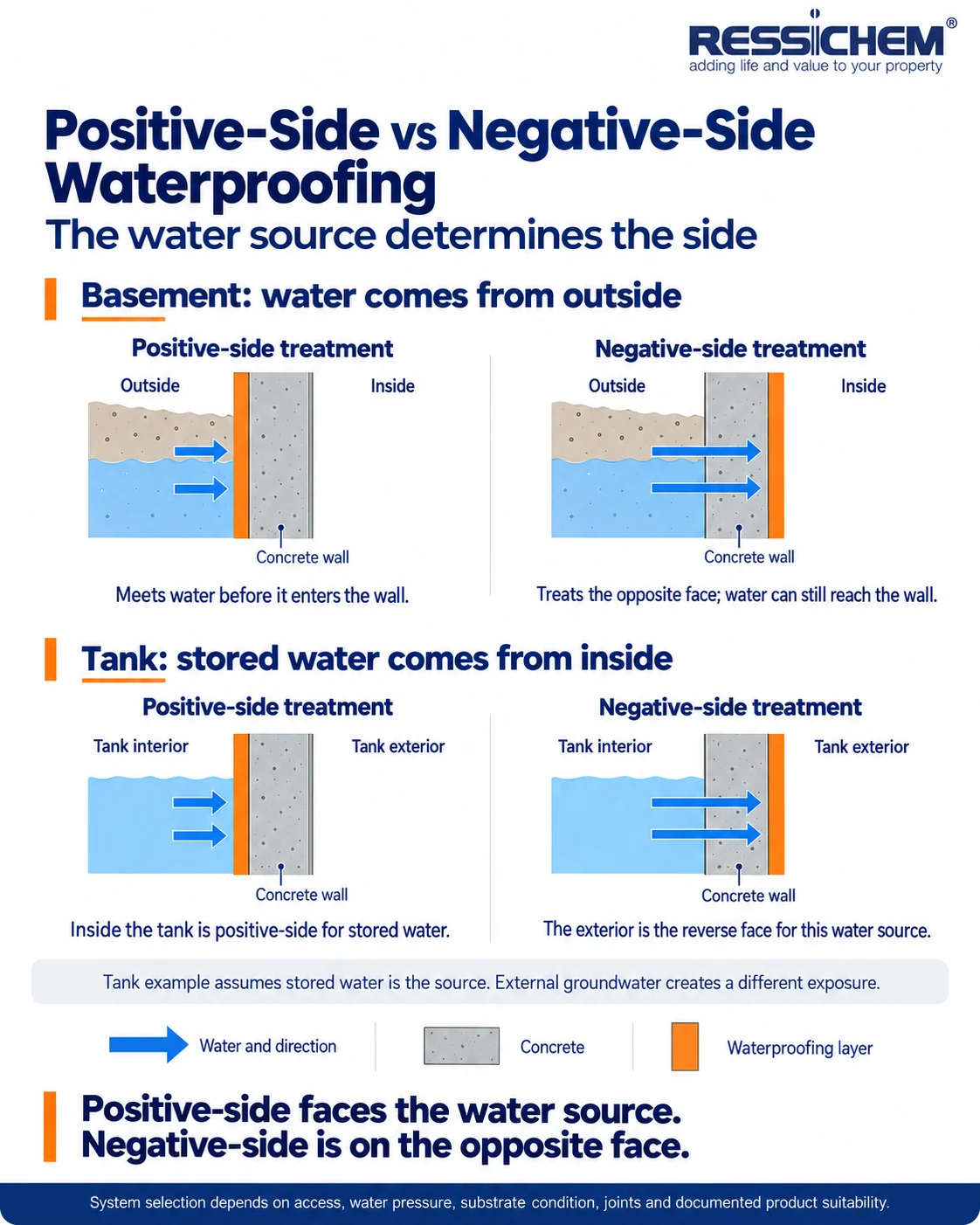
How do positive-side and negative-side waterproofing compare, and what benefits does the water-facing side offer?
A continuous, suitable positive-side layer intercepts water before it enters the treated face of the structure. Negative-side treatment can control entry into a room from an accessible reverse face, but water may still reach the wall behind it. Neither description establishes a system’s pressure capacity or service life.
The table compares surface-applied approaches conceptually. Actual performance depends on the complete assembly, its details and the specified product.
Comparison point | Positive-side treatment | Negative-side treatment |
Water source and layer location | Faces the source: outside a groundwater-exposed wall; inside a water-retaining tank | On the reverse face, opposite the water source |
Pressure direction at a bonded layer | Generally presses the layer towards its backing | Generally acts from behind the layer towards the room |
Substrate exposure | Intercepts water at the treated face when continuous and suitable | Water can still reach the structure behind the treatment |
Access | Requires access to the water-facing location | Uses the accessible reverse face |
Typical context | Often planned during construction; retrofit may be feasible | Often assessed where water-facing access is restricted |
Main limits | Continuity, protection and access still require design | Pressure suitability, substrate and details require verification |
Source notes: W. R. Meadows supports the location and access distinction; its negative-side guidance explains bond and pressure considerations; Delta Membranes explains reverse-face substrate dependence; Building Science Corporation illustrates below-grade access, drainage and continuous waterproofing considerations. This is a qualitative comparison, with no universal cost or durability ranking.
Takeaway: access determines what can be installed, while water direction and the complete system determine what must be specified.
Keep three strategies separate. A surface barrier is placed on a selected face. An integral admixture is incorporated into concrete, as Delta Membranes explains. A drainage system collects and conveys water to a discharge point; Building Science Corporation’s foundation guidance explains how drainage addresses water accumulation. These approaches may be coordinated, but one does not automatically perform the others’ functions.
Which type of waterproofing is best for your project?
The best approach is the one supported by the actual water exposure, accessible construction and a complete specification. Begin with the site, then match a system to it. A product name or an interior/exterior label is insufficient.
Work through the site conditions
Trace the water source and route. Record whether seepage follows rain, tank filling or another event. Mark visible entry points, including wall–floor junctions and pipe openings. Treat these observations as evidence for investigation, rather than a complete diagnosis.
Establish whether water pressure is involved. Hydrostatic pressure is pressure from standing or accumulated water. Building Science Corporation’s bulk-water report explains that accumulation can force water through joints, cracks and imperfections. A damp patch alone does not establish the pressure a proposed system must resist.
Map accessible surfaces. Can the water-facing side be reached during construction or exposed safely during repairs? Note neighbouring buildings, buried services and finishes that would need removal. Exterior treatment may remain possible in a retrofit, but excavation feasibility needs assessment.
Inspect the receiving substrate and details. Substrate means the concrete, masonry or other surface receiving the treatment. Record existing coatings, loose material, damaged concrete, cracks, joints and penetrations. Sika’s technical datasheet example shows why sound backgrounds and separately detailed connections matter; its instructions apply to that product, rather than every waterproofing system.
Review drainage, movement and continuity. Ask how wall treatment connects to the slab, corners and openings. Assess where collected water can discharge and how any drainage system will be maintained. Building Science Corporation’s below-grade guide shows that groundwater conditions and site access alter the overall approach; groundwater-lowering schemes require engineering design.
Check the proposed system’s documentation. Obtain the current technical datasheet, relevant application details and written clarification of any missing limits before approving the work. Refer structural movement, inaccessible below-ground work and persistent active leaks for qualified assessment.
Use the datasheet as a selection checklist
Ask the supplier or specifier to identify the supporting document for each item below. If a point is unclear, request written clarification rather than assuming a broad waterproofing claim covers it.
Pressure direction: Is the intended positive-side or negative-side exposure explicitly covered? Are test direction, method and conditions identified?
Substrate and existing layers: Is the actual concrete or masonry suitable? What preparation, repair or removal of previous coatings is required?
Service exposure: Does the system cover immersion, outdoor exposure or the proposed finish? For drinking-water contact, obtain appropriate suitability documentation for all relevant materials.
Cracks, joints and movement: What separate details are required at connections, penetrations and moving joints? What limitations apply?
Installation and return to service: Confirm required thickness, preparation, curing, environmental limits and the period before water contact from the applicable instructions.
For example, Ressichem’s RessiLurry 8PCT datasheet says laboratory performance can vary with substrate, thickness, workmanship, curing and site environment. Such qualifications matter when interpreting a headline product claim. Ask for project-specific confirmation wherever the published information does not resolve the proposed exposure.
Apply the distinction to the assembly
Below-grade wall: when outside groundwater is the source, exterior treatment is positive-side. Where exterior access is impractical, assess a documented negative-side system alongside joint repair and drainage needs. For assembly-specific discussion, see Ressichem’s foundation waterproofing page.
Tank or pool retaining water: the water-facing lining is on the inside. External groundwater is a separate exposure that also needs consideration where relevant. For an existing leaking tank, use Ressichem’s cement water tank leakage guide for the related diagnosis and repair discussion.
Roof or bathroom: where water arrives from above, treatment on the water-facing upper side follows the positive-side principle, even when the waterproofing sits beneath a finish. A ceiling patch below does not establish that the source or full assembly has been addressed. Keep application details with the relevant roof waterproofing guide and wet-area system specification.
Is negative-side waterproofing effective, and when is a specialist needed?
Yes. A properly specified negative-side system can be effective within its documented conditions, particularly where the water-facing surface is inaccessible. Effectiveness depends on pressure, a suitable substrate, adhesion and continuous treatment of the relevant details. As a technical example, Sika’s Sikalastic-1K datasheet expressly includes negative-pressure basement applications and reports a specific test configuration; it does not establish a rating for other products.
For a bonded surface layer, reverse-side water pressure acts towards the room and tends to push the treatment away from its supporting surface. W. R. Meadows’ negative-side guidance explains the need to resist pressure without losing bond. The proposal must account for that loading and the receiving surface’s condition. A negative-side label alone provides no assurance about cracks, joints or untreated water routes.
Arrange specialist assessment when water is actively flowing, seepage returns after treatment, concrete is loose or damaged, cracks indicate movement, or drainage is ineffective. Ask the assessor to explain the likely water route and the roles of leak stopping, crack repair, surface treatment and drainage in the proposed solution.
A coating does not perform structural repair. Likewise, an interior drain collects water and routes it away; its location indoors does not make it a negative-side coating. Building Science Corporation discusses injection sealing and interior drainage as separate responses to foundation leakage. The appropriate combination depends on the investigation.
Positive-side aur negative-side waterproofing mein kya farq hai?
Positive-side waterproofing is applied to the surface facing the water source, while negative-side waterproofing is applied to the opposite surface. For a basement affected by outside groundwater, the exterior is generally positive-side; for a tank retaining stored water, its internal lining is positive-side. The appropriate system depends on the water source and pressure, access, substrate condition and the product’s documented suitability.
Choose the system by water direction and site conditions
Positive-side and negative-side waterproofing identify where treatment sits relative to the water source. Access, pressure, water routes, substrate and joints determine whether the proposed system is appropriate. A useful recommendation should address those conditions and explain any additional repair or drainage work.
Explore Ressichem’s waterproofing chemical range. Before requesting a system recommendation, share the water source, the side you can access, the substrate, photographs and whether leakage is active or recurring. Match the proposed materials to current datasheets and project-specific technical advice.
Frequently asked questions
Can the same product work on both sides?
Some products are documented for both applications. Ressichem describes RessiLurry 8PCT as suitable for positive- and negative-side waterproofing on concrete and cementitious substrates, and its linked technical datasheet repeats that claim. This is a manufacturer-stated scope, not confirmation of equal pressure capacity in both directions or suitability for every assembly. Obtain written confirmation of the intended pressure, substrate, exposure and detailing before specifying it.
How much does negative-side waterproofing cost?
The cost depends on the area, substrate condition, water pressure, access and specified system. Crack and joint repairs, removal of existing finishes, active-leak treatment and any drainage work can also affect the quotation. Request an itemised estimate following a site assessment, since a coating-only price may exclude work needed to address the leakage.