
Thin epoxy coating systems can be well below 1 mm: Sherwin-Williams gives an example of about 0.28–0.64 mm for a thin system, including its specified layers. Formulated poured or aggregate-filled mortar systems can build to several millimetres. A 1 mm, 3 mm or 6 mm specification must identify the selected system and what its thickness includes, rather than assigning a universal traffic rating.
For a project in Pakistan, the useful question is not just “How thick is epoxy floor coating?” Ask which material achieves that build, how the background will be prepared, and what evidence supports the proposed use.
What does “epoxy thickness” actually measure?
“Epoxy thickness” can describe one coat, the main flooring body, or the complete resin assembly. A useful specification states which of these is being measured and whether the figure concerns freshly applied or cured material.
Single coat: one application of a named product. Its thickness does not automatically equal the finished floor build.
Wet film: the coating thickness while it is freshly applied, before its documented drying or curing process is complete.
Cured or dry film: the resulting coating layer assessed after the required drying or cure stage. It should not be assumed equal to the wet reading.
Flooring body or screed: the main formulated resin layer, sometimes incorporating specified aggregates or fillers.
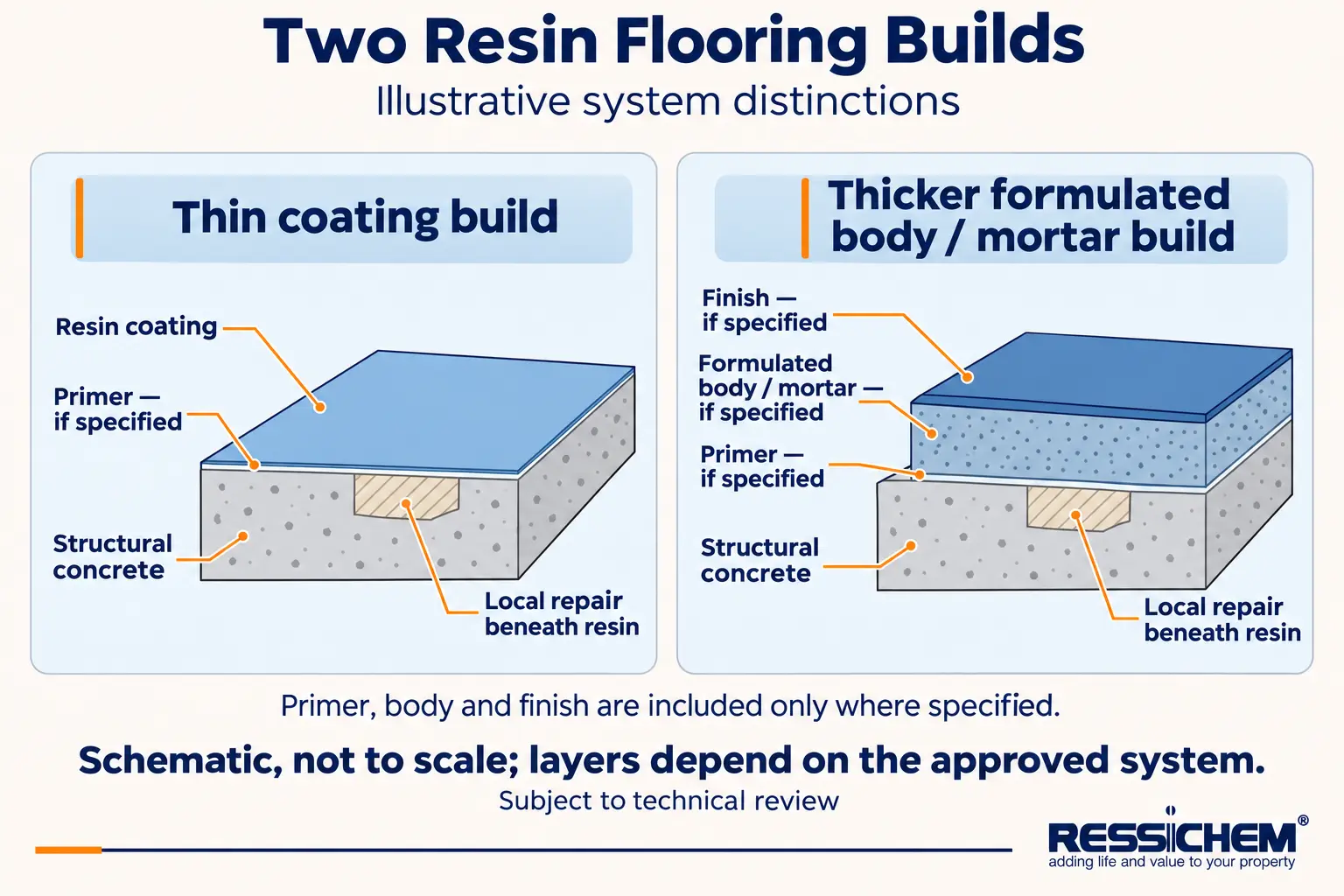
Total system build: the stated combination of compatible layers. The specification must say whether primer, body, aggregate, grout coat, or finish is included.
Repair or levelling material beneath the resin and the structural concrete slab are not automatically part of the quoted resin thickness. A contractor proposing “two coats” should therefore identify each product and its intended thickness or consumption; coat count alone cannot establish the final build.
Ask whether a nominal figure is a target, an agreed minimum, or a description of the body layer. Agree tolerances and measurement before ordering so the installer and buyer are not working to different meanings.
Millimetres, microns and mils explained
A millimetre, micron, and mil are different units. One millimetre equals 1,000 microns; one mil is 0.001 inch, equal to 25.4 microns or 0.0254 mm. A mil is not a millimetre.
The table converts the three reference builds used in this guide. These are arithmetic equivalents, not additional test results or approved duty grades.
Millimetres (mm) | Microns (µm) | Mils (approximately) |
1 mm | 1,000 µm | 39.4 mils |
3 mm | 3,000 µm | 118.1 mils |
6 mm | 6,000 µm | 236.2 mils |
Mils are rounded to one decimal place. Check the written unit in the quotation and technical datasheet rather than interpreting an unlabeled number such as “3” or “200.”
How do thin coatings, self-leveling floors and mortar systems differ?
The system family describes the material and application approach, not just the final number. Thin coatings, formulated poured floors, and aggregate-filled mortars should not be treated as different amounts of one interchangeable liquid.
Thin coatings use the specified coating layers over an approved background and primer arrangement. Ressichem’s thin-coating range is a relevant browsing route, but the selected product’s instructions must define its actual build. A thin finish is not a substitute for repairing significant slab damage.
Poured or self-leveling floors use a formulation and placement method designed for their stated build and finish. “Self-leveling” does not mean an uneven or damaged slab needs no preparation. Confirm flatness, repairs, material identity, and the intended finished level before installation.
Epoxy mortar or screed systems incorporate a specified resin/aggregate combination. The word “screed” alone is insufficient: identify the chemistry, because an epoxy mortar and a polyurethane-cement system are not the same material. Category labels do not establish that their performance or thickness limits are interchangeable.
What do 1 mm, 3 mm and 6 mm specifications mean?
The numbers 1 mm, 3 mm and 6 mm are useful nominal comparison points, not universal flooring grades. Each needs a named system, layer definition, and site-specific specification.
For manufacturer context, the Ressi EPO Tough Might TDS states trowel application at 300–4,000 microns, equivalent to 0.3–4 mm. That is the named product’s application range, not an automatic total-assembly thickness or proof of identical performance throughout the range. Confirm the intended layer and finished-build interpretation before specifying it.
For a thicker mortar example, Sika Canada’s Sikafloor Morritex Trowel System sheet, edition 12.2020/v1, documents a 3–6 mm aggregate-filled epoxy screed and a separately detailed 6 mm heavy-duty configuration. Its mortar, primer, grout-coat, and finish instructions show why a body thickness is not the entire specification. This is Canadian manufacturer evidence, not a Ressichem equivalent or a claim of local availability.
Nominal build | System context | What must be confirmed | Evidence boundary |
1 mm | A compatible formulated product layer or assembly, where specified | Layer identity, finished/wet basis, full build, and service requirements | Within Tough Might’s stated application range; no universal duty approval |
3 mm | A specified poured/trowelled body or other approved build | Preparation, product limits, included layers, and finish | Within the named range; does not establish a warehouse or load rating |
6 mm | A designed aggregate-filled mortar/system | Mortar body versus total assembly; primer, grout coat, and finish details | Sika’s named external example; no Ressichem 6 mm equivalence inferred |
The same nominal thickness can describe different materials, layers, and finishes. “1 mm for homes, 3 mm for warehouses, 6 mm for all heavy industry” is not a complete specification. Do not achieve a thicker figure by pouring a thin-film product beyond its instructions.
What determines the thickness your floor needs?
The required build follows the slab, service conditions, and selected formulation together. Thickness is one design input; surface wear requirements and the structural capacity of the concrete slab are different questions.
Describe the type and frequency of traffic, loaded vehicles, wheel conditions, equipment loads, and possible impact. Ask which documented system addresses those conditions rather than expecting a millimetre value to function as a load rating. Uncertain structural capacity needs competent assessment.
Record chemicals, cleaning agents, washing routines, and thermal exposure. Request product-specific resistance evidence for the actual service. Increasing thickness alone does not establish chemical or heat suitability.
Review slab flatness, defects, finish or texture needs, and the height available at doors, drains, thresholds, and adjoining floors. The proposed build should explain those transitions and any local repairs instead of assuming the same depth can be applied everywhere.
Include operational constraints: access, work zones, and when each area must return to its intended use. Product limits and site conditions influence application and curing; Ressichem’s temperature and humidity guide provides related context, while the current selected datasheet governs actual acceptance values.
Why preparation and repairs still matter
A thicker covering cannot compensate for an unsuitable background. Assess soundness, contamination, surface profile, moisture, and compatible repairs before deciding that additional resin thickness is the solution.
Sherwin-Williams’ concrete-preparation guide separates inspection, decontamination, profiling, and repair work. Profiling means creating the texture needed for the selected material to bond. Local patch depth should be documented separately from the nominal finished resin build.
Moving cracks, structural defects, and joints need assessment and agreed detailing; covering them with more material does not establish that the underlying problem is resolved. Confirm compatible priming and the background’s readiness before application. Ressichem’s installation guide explains how preparation, layer installation, and handover connect.
Is thicker epoxy always better?
No. The useful choice is a system that meets the required service within its documented application limits. Extra material cannot correct incompatible chemistry, poor preparation, or incorrect curing.
Confirm limits for each layer as well as the intended assembly. A product documented for a particular range should not be applied beyond it simply to match a more impressive quotation. Any proposed deviation needs manufacturer review rather than a generic maximum-pour rule.
Compare alternatives by the complete build, preparation, finish, and performance evidence. Higher component counts, product numbers, or nominal thickness do not by themselves establish a better floor.
How can the specified thickness be checked?
Agree a quality-control plan before work begins, covering suitable application checks, consumption records, and an appropriate assessment of the cured build. The method must suit the material, substrate, layer being assessed, and agreed acceptance criteria.
For suitable coatings, Elcometer’s dry-film guidance explains a prediction based on wet-film thickness and the product’s volume-solids fraction:
Predicted dry-film thickness = wet-film thickness × documented volume-solids fraction.
Use that relationship only where the selected coating data and measurement conditions support it. It is not a method for certifying the total thickness of an aggregate-filled multilayer floor, and a wet reading does not prove the final assembly.
Record product and batch identities, measured application area, material used, and relevant conditions. Compare consumption with the selected build while accounting for documented site factors; material-use records support the review but are not proof of uniform thickness at every point.
Have a competent inspector agree suitable equipment, sampling, and acceptance. Confirm that the instrument is suitable for the actual substrate; equipment intended for coating measurements on steel should not be assumed suitable on concrete. Any assessment that damages the floor needs an agreed method and repair arrangement.
Buyer/specifier checklist
Use this checklist to make a proposal reviewable; it is not an installation standard.
Exact system and product identities, with current technical documents.
Each layer’s purpose and specified thickness or consumption.
Whether the quoted build includes primer, aggregate, grout coat, or topcoat.
Nominal finished thickness, its measurement basis, and agreed tolerances.
Preparation, local repairs, joints, and site acceptance requirements.
Inspection method, records, sampling, and acceptance responsibility.
Product-specific cure/release requirements and the intended operational use.
Thresholds, drains, and height transitions to adjoining surfaces.
Resolve unclear terms before comparing prices. A quote for a body layer and one for the complete finished assembly may display the same number while covering different work.
Agree the complete system before choosing a thickness
Before buying materials, confirm what the thickness number measures and how the selected build meets the project’s actual conditions. Keep repairs, structural capacity, resin layers, and inspection requirements clear in the specification.
Explore Ressichem’s epoxy flooring and coating systems and share floor use, traffic/load details, area, slab condition, existing coatings, moisture findings, finish needs, and height constraints for material and system guidance. The category helps with range selection; it does not itself define an installed contract or approve a thickness from incomplete information.
Epoxy floor coating kitni moti honi chahiye?
The required thickness depends on the specified epoxy system, the concrete condition, and the floor’s intended use. Thin coatings and thicker formulated flooring or mortar systems serve different requirements, so 1 mm, 3 mm, and 6 mm are not universal duty ratings. Confirm whether the quoted thickness refers to one layer or the complete cured build, and check the selected product’s application limits, preparation requirements, and inspection method.
Frequently asked questions
Is epoxy 100% waterproof?
Not as a blanket statement about every floor. A cured product’s documented water resistance does not establish a watertight assembly, moisture-vapour control, or crack/joint treatment. Confirm the actual system’s limits and any separate waterproofing requirements; thickness alone does not settle them.
How much does 1,000 sq ft of epoxy cost?
Area alone cannot establish the cost: floor condition, preparation, specified products and build, labour, details, and site logistics must be included. Thickness affects material requirements but is only one cost input. Request an itemized, current quotation for the measured floor; no verified PKR rate is supplied for this guide.
Is 3 mm epoxy flooring suitable for every industrial floor?
No. A nominal thickness is not a load rating. Suitability depends on the selected formulation, complete system, concrete condition, traffic, impact, and chemical exposure. Ask the supplier to confirm the specified build for the actual operating conditions rather than treating 3 mm as a universal industrial specification.
Does a two-coat epoxy quote tell me the finished thickness?
No. Coat count alone does not establish the finished build. The quotation should identify each product, its specified consumption or thickness, whether figures refer to wet or cured material, and which layers are included. Agree how the completed thickness will be checked before work starts.