
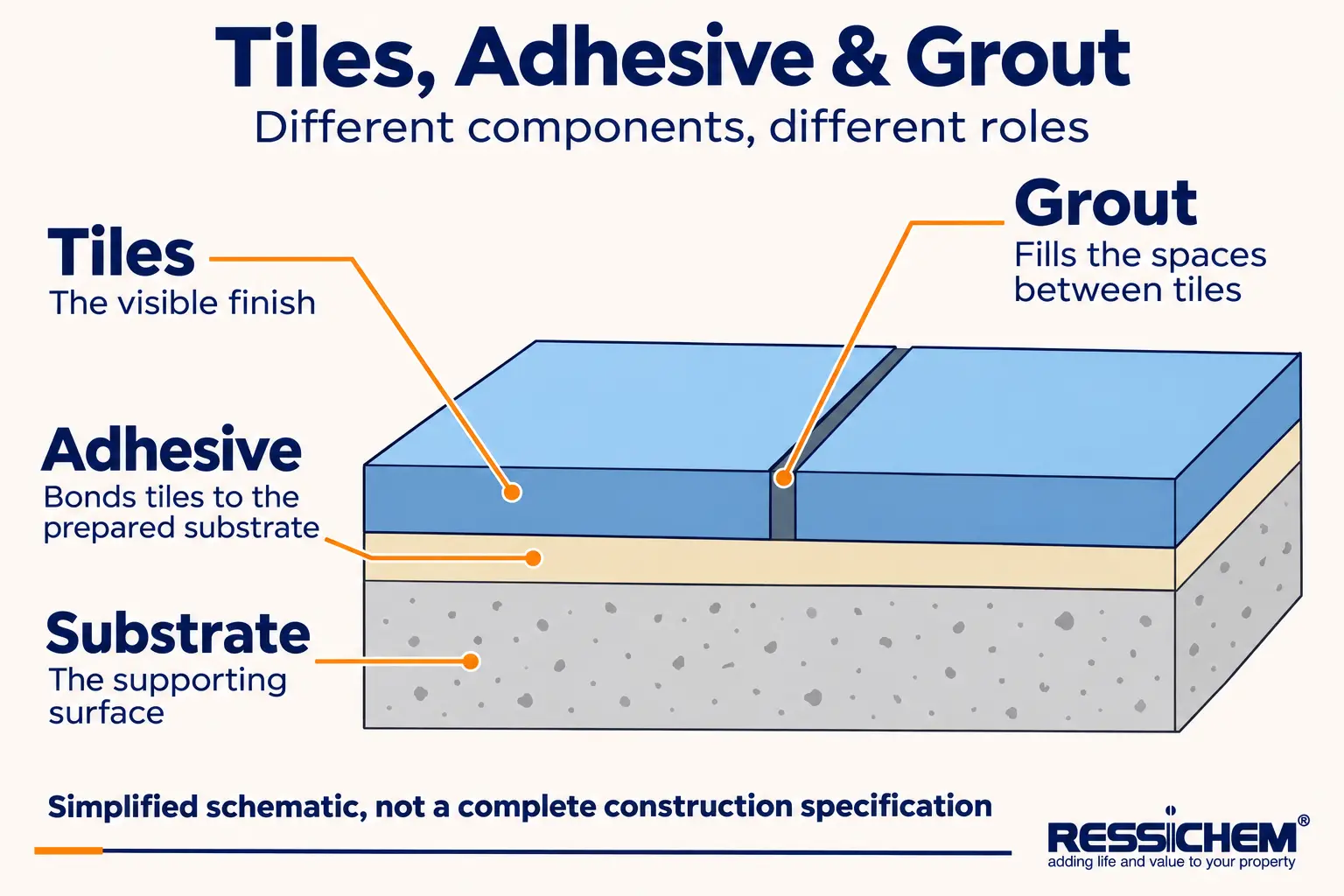
Tile adhesive bonds tiles to a prepared substrate, while tile grout fills the joints between tiles after the adhesive has set sufficiently. Most conventional tile installations need both, selected for their separate jobs. Standard products are not interchangeable; an exception requires explicit manufacturer approval for both uses.
In Pakistan, “tile bond” usually refers to the adhesive. When buying materials, identify the bonding product and joint filler separately, then check that each suits the tile and installation conditions.
Tile grout vs tile adhesive at a glance
The main difference is function and placement: adhesive works below or behind the tile, while grout fills appropriate joints between adjacent tiles. This comparison describes ordinary products; it does not establish any dual-purpose approval.
Comparison point | Tile adhesive | Tile grout |
Main purpose | Bond tiles to the prepared background | Fill and finish appropriate joints |
Placement | Beneath floor tiles or behind wall tiles | Between adjacent tile edges in designated grout joints |
Installation stage | During tile fixing | After adhesive has set sufficiently for grouting |
Key selection checks | Tile, substrate, wall/floor position, exposure, approved build | Tile compatibility, joint width, exposure, cleaning, finish |
Likely consequences of wrong use | Unsuitable bonding material or use may compromise the tile bond | Unsuitable joint material or use may cause joint/finish defects; it cannot remedy a failed bond |
A well-finished joint does not prove that the tile beneath it is properly bonded. Ressichem’s tile adhesives and grouts share one range destination, but they still need to be selected for different roles.
What is tile adhesive used for?
Tile adhesive forms the bonding layer between the tile and its substrate—the prepared supporting background, such as an approved cementitious wall or floor. Its suitability depends on the tile, background, position, and service conditions.
For example, the Ressi TA 210 datasheet describes a cement-based adhesive for mosaic, ceramic, and general homogeneous tiles on relevant cementitious surfaces. That is a documented application scope, not approval for every porcelain tile, natural stone, background, or demanding exposure.
A suitable adhesive still requires a sound, appropriately prepared surface. The same sheet addresses loose material, oil, unsound areas, and dust on tile backs. Choosing a familiar bag name does not remove the need to inspect the background and follow the selected instructions.
Adhesives can be cementitious or resin-based, with different product-specific requirements. Ressichem’s epoxy tile-adhesive datasheet illustrates that an epoxy formulation can be a bonding product. “Epoxy” identifies chemistry; it does not automatically mean “grout” or establish approval for both functions.
What is tile grout used for?
Tile grout fills and finishes the designated joints between tiles after the bonding material is ready for grouting. Joint preparation and product compatibility matter; grout should not be expected to hold poorly bonded tiles in place.
Ressi TG 810 is documented as a cementitious joint filler for ceramic tiles and natural stone, positioned for dry areas. Its instructions require the adhesive to have set firmly and the joints to be clean before grouting.
Ressi TG 820 is also cementitious, but its datasheet describes a water-resistant grout with stated bathroom and swimming-pool applications. Confirm the complete system for the actual moisture or immersion conditions; this does not mean grouting alone makes the installation waterproof.
Cementitious and epoxy grout are formulation families, rather than universal performance grades. Match the exact product to the joint, tile, cleaning regime, and exposure. Sealing is also product-dependent: TG 810’s sheet states that no sealer is required after application, so “all cement grout needs sealing” would be inaccurate.
Waterproofing is a separate system consideration. ARDEX’s wet-area guidance explains that moisture can reach a background through cementitious grout and adhesive bedding. A water-resistant grout claim therefore does not replace assessment of the membrane, background, and joint details required for the installation.
Do you need both grout and adhesive?
Most conventional tile installations use adhesive for bonding and grout for appropriate tile joints. Treat them as coordinated parts of a system, with any waterproofing and movement details specified separately.
Assess and prepare the background, including any specified waterproofing and compatibility checks.
Install the tiles with a suitable adhesive using its approved method.
Allow the adhesive to set sufficiently under the selected system’s instructions before grouting.
Prepare and fill the appropriate joints with the selected grout.
Follow the system’s curing, cleaning, traffic, and water-exposure restrictions before use.
This is a general sequence, not a universal timetable. The TG 810 and TG 820 instructions both require the adhesive to have set firmly; the actual waiting and use conditions must match the chosen products and site.
Designated movement joints require their specified sealant or joint system rather than being treated as ordinary grout joints. The TA 210 instructions specifically caution against simply tiling over expansion joints. Agree the relevant detail with the specifier or technical supplier.
Can grout and tile adhesive replace each other?
Ordinary grout is not a substitute for the specified tile adhesive, and ordinary adhesive should not be selected as decorative joint grout. Only use a product for both jobs if its exact documentation explicitly approves both functions.
A grout may adhere to the sides of a joint, but that does not establish that it can bond the tile to its supporting background. Likewise, an adhesive’s bonding role does not establish the joint-filling, finish, or cleaning requirements expected of the selected grout.
Do not infer dual-purpose approval from a shared ingredient, a similar color, or an epoxy label. No dual-use approval for a named Ressichem product is established in this guide. Ask the supplier to identify the intended role on the current product document before using leftover material for another job.
How to choose the right adhesive and grout
Choose both materials against the same project requirements while checking each product’s separate purpose. Provide the supplier with the following information and ask which documentation confirms compatibility.
Tile material and size: identify ceramic, porcelain, stone, or another tile, plus its dimensions and backing. For sensitive stone, request confirmation of compatibility and appearance considerations.
Substrate and condition: describe the supporting surface, existing finish, and any weak, contaminated, damp, or uncertain areas. Check the adhesive’s preparation and approved-background requirements.
Wall or floor position: confirm the adhesive’s intended application and any relevant tile-weight or support considerations instead of assuming every product suits both.
Joint dimensions: obtain the grout manufacturer’s approved joint-width information and the agreed joint detail; do not choose a generic width from an unrelated product.
Dry, wet, exterior, or submerged exposure: verify that the chosen materials and complete system cover the actual conditions. Bathrooms and pools need more than a “water-resistant” label.
Use, cleaning, and appearance: describe service exposure, cleaning products, desired color, and finish. Ask for the exact product’s relevant limits rather than assuming a formulation family guarantees performance.
Record the adhesive and grout identities, the compatibility decision, and the instructions the installer will follow. If the tile or site changes, revisit that decision before substituting materials. Use current technical and safety documents for handling and application requirements.
Mistakes that can cause tile or joint problems
Problems can arise when a material is suitable in principle but selected or used for the wrong conditions. Avoid these common shortcuts:
Choosing by color or bag price while ignoring documented suitability.
Using joint filler for tile bonding, or adhesive for an unapproved grouting role.
Grouting before the adhesive is ready, or leaving joints obstructed or contaminated.
Assuming grout supplies the complete waterproofing or replaces movement detailing.
Covering unresolved substrate or movement problems with more material.
Cracked grout, loose tiles, and leaks can have several causes and need diagnosis. Regrouting alone does not restore a failed adhesive bond or repair a defective substrate. Ressichem’s article on causes of tile failure provides related reading; the actual defect still needs assessment.
Match the bonding product and joint filler to the installation
Use adhesive to establish the specified tile bond and grout to fill the appropriate joints once that bond is ready. Confirm waterproofing, movement details, product compatibility, and use restrictions as part of the complete installation.
Explore the Ressichem tile bond and grout range and provide the tile, substrate, joint width, and exposure details when confirming suitability. A clear specification for both products is more useful than treating grout and adhesive as interchangeable materials.
Tile grout aur tile adhesive mein kya farq hai?
Tile adhesive bonds tiles to a prepared surface, while tile grout fills the joints between adjacent tiles after the adhesive has set sufficiently. Most conventional installations need both because the products perform different jobs. Choose each for the tile, background, joint width, and exposure, and follow the selected manufacturer’s instructions. Water-resistant adhesive or grout alone does not establish a waterproof tiled assembly.
Frequently asked questions
Can tile adhesive be used as mortar?
Some cementitious tile adhesives are tile-setting mortars, but that terminology does not approve them for every mortar job. Do not assume suitability for general masonry, thick bedding, levelling, or repairs. Follow the exact product’s approved purpose and bed-depth limits; see the tile bond vs cement mortar comparison for related context.
How long will tile adhesive last?
For an unopened bag, check the product’s shelf life and storage requirements. After mixing, pot life concerns usability in the container, while open time concerns adhesive already spread and still able to receive tiles, as ARDEX’s timing definitions explain. Installed service life is a different question, influenced by product suitability, substrate, application, and exposure. Check the latest datasheet and investigate actual failure rather than assuming one universal lifespan or warranty.
Can I use grout instead of tile adhesive?
No. Tile adhesive bonds tiles to the prepared background, while grout fills the appropriate spaces between tiles after fixing. Using grout as the bonding material, or adhesive as an unapproved joint filler, can compromise the installation. Select each product for its documented purpose and check compatibility across the specified system.
Do tile adhesive and grout make a bathroom waterproof?
Water-resistant adhesive or grout does not, by itself, establish a waterproof bathroom. Wet areas need a suitable waterproofing system and correctly detailed junctions, penetrations, and movement joints. Check how the membrane, adhesive, grout, and sealants work together before installation.