
The main types of epoxy flooring include thin-coat systems, self-smoothing floors, aggregate-broadcast or slurry systems, trowelled epoxy mortar, decorative finishes, and specialist electrostatic-control floors.
They differ in build-up, texture and intended duty. Water-based, solvent-based and 100% solids describe how a product is formulated; they are not three interchangeable finished floor designs. The best option depends on the concrete, traffic, spills, slip requirements and appearance you need.
How Are Epoxy Flooring Types Classified?
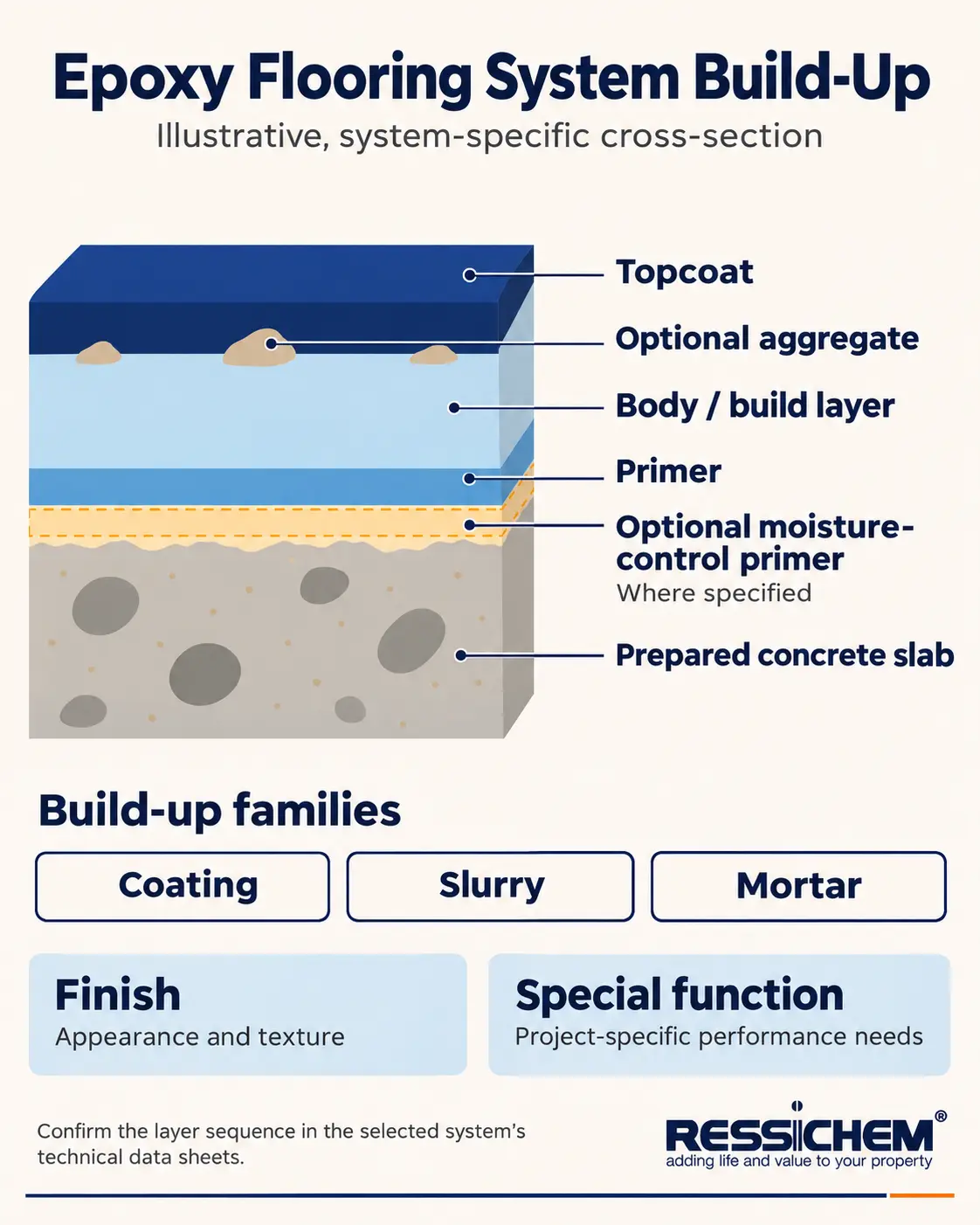
An epoxy floor is a system of compatible materials applied over a prepared substrate. It may include a primer, one or more body coats or aggregate layers, and a finish coat. There is no fixed number of types: “type” can refer to the system build-up, its finish, or a special performance requirement. These descriptions overlap: a self-smoothing body coat, for example, can be pigmented and used in a larger system.
A useful starting distinction is coating, slurry or mortar. Coatings are relatively thin resin layers; slurries incorporate aggregate while remaining spreadable; mortars have a higher aggregate content and are placed and finished more like a screed. Sherwin-Williams’ epoxy flooring guide uses this broad build-up distinction. There is no universal rule that an epoxy layer becomes “flooring” at exactly 2 mm: specify the manufacturer’s complete system and thickness for the job.
The Main Epoxy Flooring Systems and Where They Work
1. Thin epoxy floor coatings
A thin-coat system uses one or more roller, brush or spray-applied layers over a suitably prepared floor. It can provide a cleanable protective finish for spaces with the traffic and exposure specified for that system. The term “epoxy paint” is often used loosely, but a single decorative paint coat should not be assumed to provide the same build, wear resistance or service life as a specified multi-layer flooring system.
Consider this route for light-duty rooms, utility areas or floors that need a protective finish without a heavy build-up. Ask for the primer, coating sequence, expected traffic and cleaning-chemical resistance, rather than choosing by sheen alone.
2. Self-smoothing or self-leveling epoxy floors
A self-smoothing epoxy formulation flows after placement to create a continuous, comparatively smooth surface. It is commonly considered for commercial interiors, showrooms and some industrial areas where a seamless, easy-to-clean finish matters. It does not correct a structurally unsound or badly uneven slab by itself; cracks, contamination and substrate levels need assessment and preparation before installation.
The final slip resistance, wear and chemical performance depend on the full build-up and selected finish. A smooth version may not suit wet work zones unless texture is designed into the system.
3. Quartz-broadcast and epoxy slurry systems
Broadcast systems scatter graded aggregate into a wet resin layer, then seal or finish it as specified. Slurry systems mix aggregate into the resin before spreading. Both can add build and texture, but the chosen aggregate, amount and topcoat affect cleanability and slip resistance. They can suit workshops, circulation routes and demanding commercial or industrial floors when the system is designed for the expected use.
The old article calls one option “self-dispersing epoxy.” That term does not give a buyer enough information about the actual build-up. Ask whether the proposal is a broadcast, slurry or other specified system, and what performance it is designed to provide.
4. Trowelled epoxy mortar floors
Epoxy mortar combines resin and graded aggregate in a stiffer mix that is placed and trowelled. It is used in selected heavy-duty floor builds or local repairs when mechanical loads and substrate conditions call for it. A mortar is not automatically the best choice for every warehouse: the designer must also check traffic, impact, chemical spills, thermal exposure and the condition of the concrete beneath it.
5. Decorative flake, quartz, metallic and terrazzo finishes
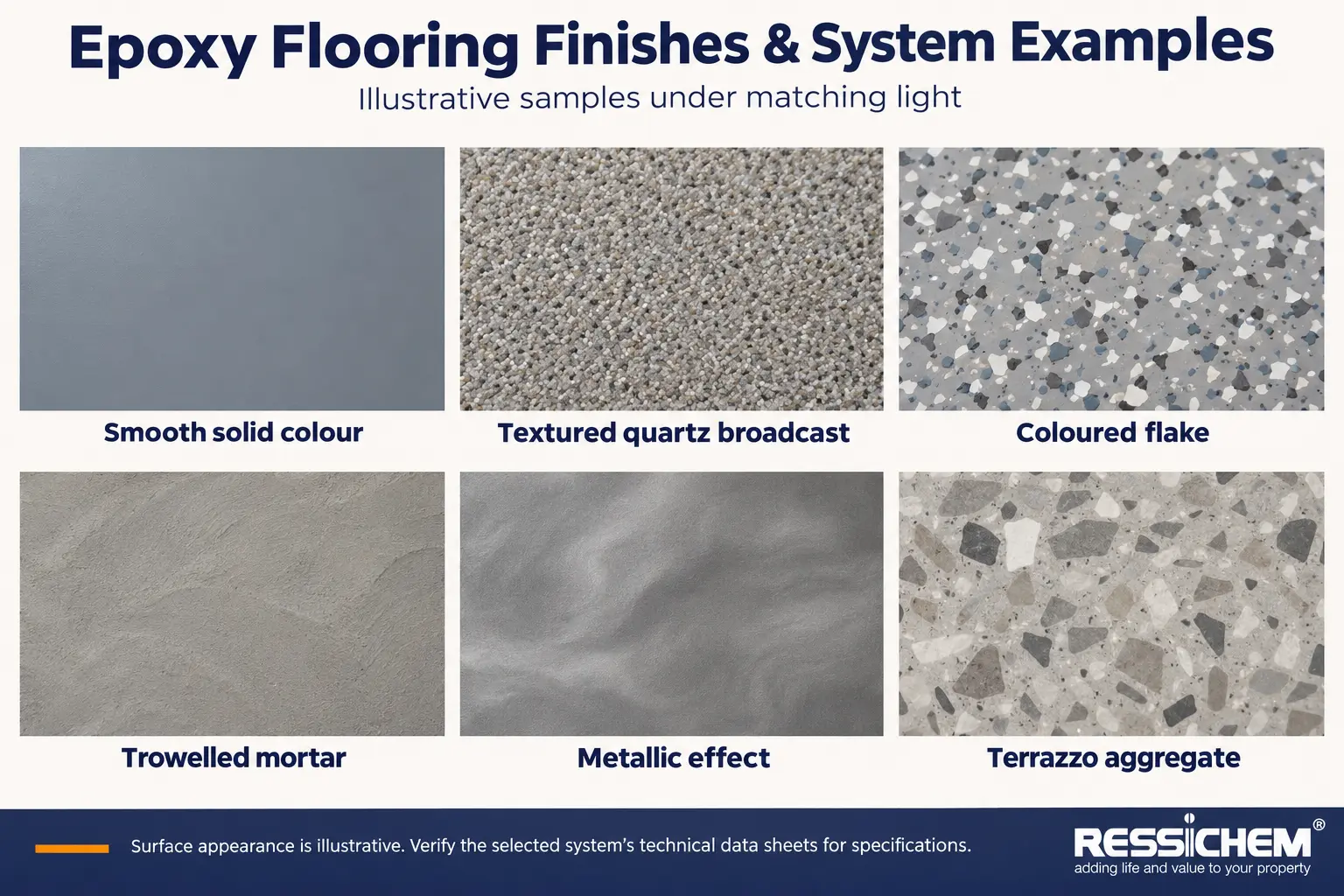
Decorative options describe the visible finish, not necessarily a separate base chemistry. Flakes or coloured quartz may be broadcast into an epoxy layer; metallic pigments can create a patterned appearance; epoxy terrazzo uses aggregate within a designed decorative system. Some projects call for a clear or other compatible finish coat. Ask for a physical sample so colour, texture, gloss and slip resistance are judged together.
“Gravel epoxy” in the older article is best understood as a decorative aggregate system, with aggregate size and the full floor build specified. Appearance alone does not establish suitability for outdoor UV, heavy vehicles or wet conditions.
6. Electrostatic-control epoxy floors
Conductive or static-dissipative epoxy floors are specialist systems for areas where electrostatic discharge must be controlled, such as certain electronics or sensitive production settings. Their performance involves the full flooring build, grounding design, footwear and testing method. An ordinary epoxy floor is not automatically antistatic. Sika’s ESD product data provides an example of how a specific system is qualified; obtain the relevant test requirements for your facility.
7. Moisture-mitigation epoxy systems
A moisture-control primer or barrier may be specified beneath a flooring system when testing shows that the slab has elevated moisture vapour. It is a substrate-management component, not a general-purpose decorative floor type and not a cure for active water movement. Ressichem lists an epoxy system for high-moisture substrates; its conditions and compatible layers must be checked against the current technical data sheet and site assessment.
Are Water-Based, Solvent-Based and 100% Solids Different Floor Types?
These terms describe a product’s formulation or carrier, not the appearance or duty class of the installed floor. A water-dispersed epoxy contains water in the application formulation; a solvent-based product contains solvent; a 100% solids product has no added volatile water or solvent in that sense.
Each can be formulated for particular roles, such as a primer, coating or build layer. The label alone does not prove higher durability, zero odour, faster installation or a particular service life.
Compare the specific product’s solids content, VOC information, substrate tolerance, mixing and cure requirements, and performance data. Applicable site regulations and ventilation requirements should be checked from the current data and safety sheets.
Which Epoxy Floor Finish Should You Choose?
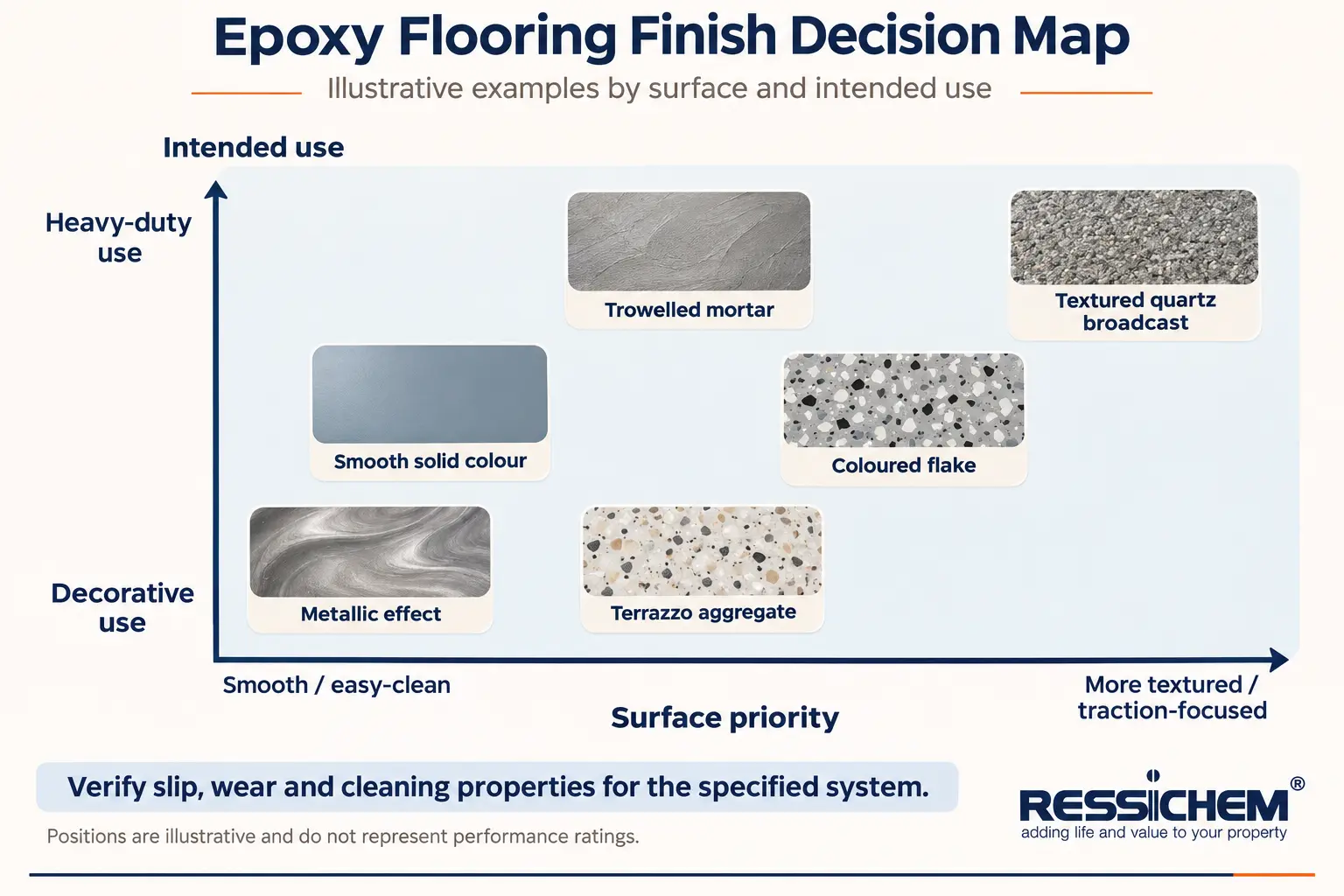
Finish affects cleaning, appearance and traction. Smooth gloss or satin finishes may suit clean commercial areas, while a textured broadcast or aggregate system may be needed where water or contaminants make a smooth floor slippery. Flake, quartz, metallic and terrazzo effects are appearance choices that still need the correct underlying build-up. Sample the finish in the actual lighting and check the required slip performance for the space.
How to Choose the Best Epoxy Flooring Type
Start with the floor’s job. For a light-duty interior, a specified coating may be enough. For a seamless commercial finish, consider a self-smoothing system. For wear and traction in a workshop, compare quartz-broadcast or slurry options. For heavy mechanical duty, a mortar or other engineered build may be appropriate. An electronics area needs a verified electrostatic-control system if the facility specification calls for it.
Then assess the slab and environment: concrete soundness, existing coatings, cracks, moisture vapour, traffic, impacts, chemicals, cleaning, wet use, UV exposure and downtime. A floor that looks dry can still have moisture issues below the surface. Agree on substrate preparation, primer, layers, texture and cure before work begins. Ressichem’s guide to installing epoxy flooring on concrete explains the application stages; its article on early flooring failures covers common preparation and moisture problems.
Ressichem groups its epoxy flooring systems by light, medium, heavy and specialized duty. Use those categories to start a specification conversation, then check the chosen product data sheet and site conditions. For current product options, see the epoxy floorings and coatings range.
Explore Epoxy Flooring Systems for Your Project
The best comparison is a written floor specification, not a list of names. Share the floor area, slab condition, traffic, spills and finish requirements with Ressichem to discuss suitable epoxy flooring systems and their technical data sheets. Browse the epoxy floorings and coatings range to see available components before requesting a project-specific recommendation.
Epoxy flooring ki kitni types hoti hain?
There is no fixed number because epoxy floors can be classified by their build-up, finish or special function. Common options include thin coatings, self-leveling floors, quartz or flake systems, epoxy mortar and electrostatic-control floors. Choose a system based on the concrete’s condition, expected traffic, spills, slip requirements and desired appearance.
Frequently Asked Questions
What type of epoxy flooring is best?
There is no single best type. Choose by substrate condition, traffic and loads, chemical and water exposure, required traction, appearance and maintenance. A smooth coating for a light-duty room and a textured heavy-duty build solve different problems.
What are the three types of epoxy flooring?
A practical build-up classification is coatings, aggregate-filled slurries and trowelled mortars. Self-smoothing, decorative, ESD and moisture-control options add a finish, application method or special function to that broad classification. Manufacturers may use different names, so request the complete system specification.
Is an epoxy floor 100% waterproof?
A continuous, correctly specified coating can resist liquid on its surface, but joints, penetrations, cracks and moisture moving through the slab require separate detailing. The floor should not be treated as a universal waterproofing solution.
How long does epoxy flooring last?
There is no reliable lifespan for epoxy flooring as a whole. Service life depends on system build, substrate preparation, use, chemical and UV exposure, installation quality and maintenance. Ask for the proposed system’s performance data and maintenance plan rather than relying on a fixed number of years.