
The best tile bond in Pakistan is the adhesive documented as suitable for your tile material, dimensions, substrate, wall or floor position, and exposure. Correct background preparation and application matter alongside the product choice. A familiar brand or stronger-sounding bag cannot establish suitability for every bathroom, balcony, porcelain tile, or heavy stone installation.
Start with the project requirements, then compare the exact product documentation. This guide helps you prepare that discussion with the supplier and installer; the selected adhesive, tile, and background manufacturers’ current instructions should govern the final specification.
What does “tile bond” mean, and how is it different from cement-sand mortar?
“Tile bond” is commonly used in Pakistan to mean tile adhesive: the material that bonds a tile to a prepared background. The substrate is that supporting background, such as an approved concrete, plaster, screed, or existing tiled surface.
Keep the material’s role clear. A bonding adhesive fixes the tile; a bedding or levelling mortar forms or corrects the background where specified; joint grout fills the designated spaces between tiles. Selecting one does not automatically resolve the others.
Compare a proposed cement-sand mortar method and a proprietary adhesive system against the actual tile, background, and application requirements. Ask how the installer will control preparation, contact, and curing. Avoid blanket claims that every traditional method is wrong or every bagged adhesive is flexible and waterproof.
How to choose the best tile adhesive for your project
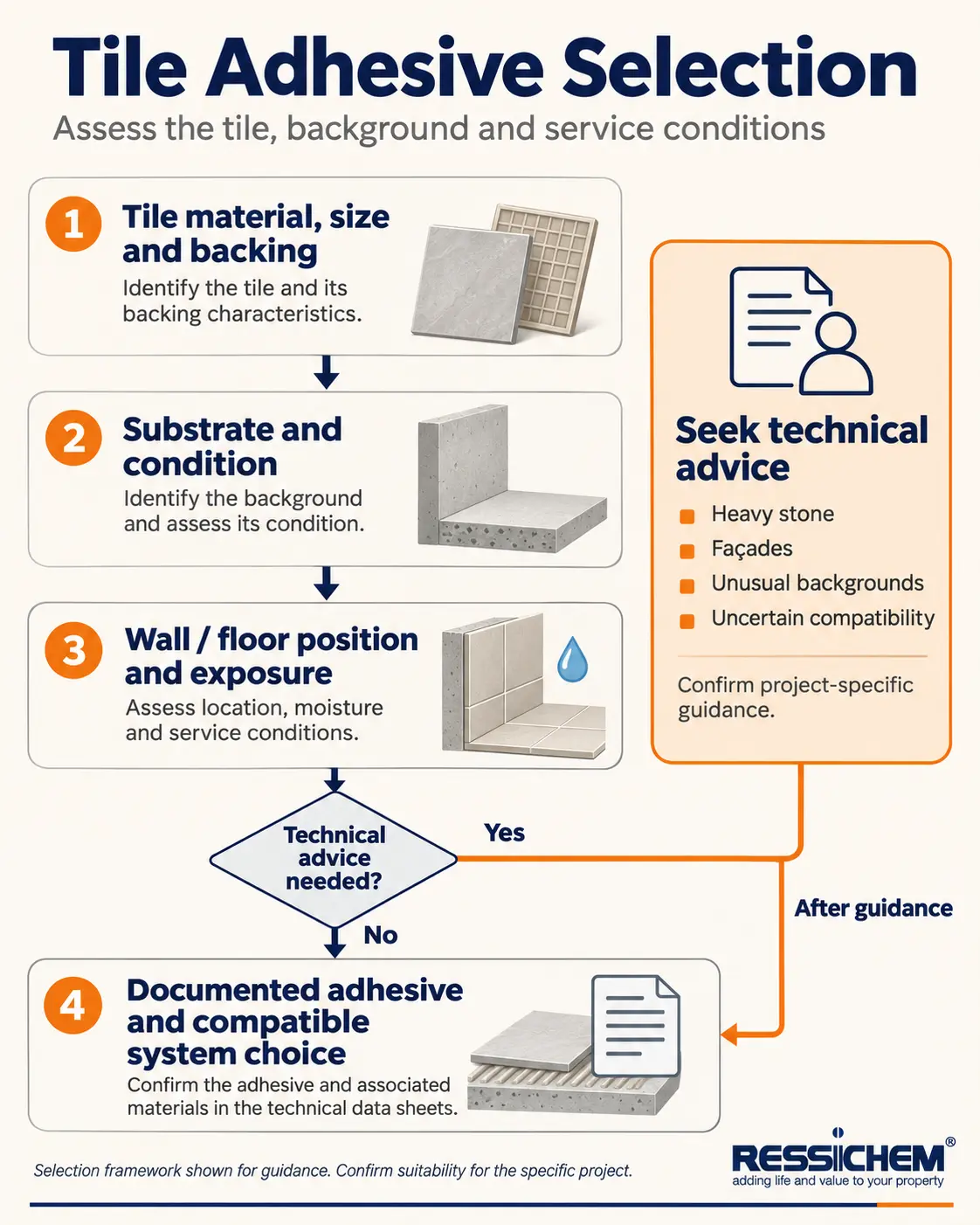
Choose tile adhesive by matching the complete installation, beginning with the tile and ending with documented compatibility. A general “floor and wall” description is a starting point, not confirmation for every background or exposure.
Identify the tile material, porosity, and backing. Dense porcelain and some backed tiles need particular compatibility checks; LATICRETE’s thin-set FAQs explain why porosity and the bond between a backing and the tile matter. Share the actual tile information rather than only its shop description.
Next, record dimensions and weight where relevant, then identify the substrate and its condition. Confirm whether the installation is on a wall or floor, indoors or outdoors, and dry or exposed to moisture. Note existing cracks, movement, coatings, or uncertainty about the background so these can be assessed before selection.
Finally, check the selected adhesive’s stated uses, limitations, preparation requirements, and application conditions. Grey or white may matter for the appearance or compatibility of a particular tile or stone, but color is not a performance grade. Ask for confirmation of the exact variant instead of assuming white or a higher product number means better.
Use this table as a supplier discussion checklist. It identifies checks, not automatic product recommendations or universal tile-size thresholds.
Project situation | What to check in the specification | When to get technical advice |
Ordinary ceramic on cementitious surfaces | Exact tile scope; sound, prepared background; installation conditions | Unknown coatings, weak plaster, cracks, or uncertain substrate suitability |
Dense porcelain / large-format tiles | Tile/backing compatibility, flatness, dimensions, contact method, product limits | No explicit size/application confirmation or unusual backing |
Wall installations | Tile weight, background capacity, slip/contact requirements, support details | Heavy tiles, installation at height, façades, or uncertain support |
Wet areas | Compatible adhesive, waterproofing approach, joint and movement details | Moisture-sensitive backgrounds, immersion, or unconfirmed membrane compatibility |
Exterior exposure | Explicit external-use scope and complete exposure/movement specification | Balconies, façades, severe exposure, or unresolved movement |
Natural stone | Exact stone and backing, moisture/staining sensitivity, adhesive compatibility | Heavy, moisture-sensitive, resin/mesh-backed, or unfamiliar stone |
Tile-on-tile renovation | Sound existing bond, surface preparation, system compatibility | Loose/unstable tiles, damp, or uncertain condition beneath existing finish |
The same tile can need a different specification when the background or exposure changes. Resolve the technical-advice column before ordering material for an uncertain or demanding installation.
Large-format and heavy tiles need more than a stronger-sounding bag
Large-format and heavy tiles require a system check: substrate flatness, supported weight, backing, adhesive contact, and product limits all need attention. ARDEX’s large-format guidance emphasizes achieving appropriate contact, rather than relying on a product description alone.
Ask the supplier and installer to agree how contact will be achieved and checked for the selected product. Exterior façades, very heavy stone, and unusual backgrounds need specialist specification, including whether additional or mechanical support is necessary. An adhesive’s stated bond strength alone cannot settle that decision.
Is a water-resistant tile bond enough for bathrooms or balconies?
No. An adhesive’s water-resistance claim does not establish that a bathroom or balcony assembly is watertight. Bonding, grout, movement detailing, and waterproofing have different roles and need compatible specifications.
ARDEX’s wet-area guidance explains that moisture can reach vulnerable backgrounds through cementitious grout joints and adhesive bedding. It treats waterproofing as a separate consideration before tiling. Use that system-level distinction rather than transferring another manufacturer’s product recipe to a Ressichem installation.
For the actual project, confirm the waterproofing approach, adhesive compatibility, joint details, and relevant exposure with the suppliers. Pools, continuous immersion, and other demanding conditions need specific technical confirmation rather than an assumption based on “wet area” wording.
Grout selection also deserves its own review for demanding joints. Ressichem’s epoxy-grout article provides related reading, while the chosen grout’s documentation should determine suitability. Grout is not a substitute for the tile adhesive or the complete waterproofing design.
How to compare brands and technical datasheets
Compare brands through documented suitability and the quality of the selection support, rather than reputation or price alone. A technical datasheet (TDS) should match the exact product and variant being supplied.
Check intended tile types, approved backgrounds, exposure, preparation, application limits, and curing requirements. Ask for the current sheet and any relevant test report or certification identifying that product. A standard’s logo or a generic range statement does not prove every adhesive has the same classification.
An adhesive classification summarizes defined performance characteristics under a referenced standard; it does not specify the entire tiling assembly. Ressichem’s BS EN 12004 explainer offers background, but obtain technical confirmation of the selected product’s classification and compatibility rather than choosing from a code alone.
Before purchase, check the product identity, batch details, storage condition, and usability against the manufacturer’s instructions. Confirm whom the installer can contact if the site differs from the agreed specification.
Compare total system cost: suitable adhesive, background preparation, specified coverage, labor, any waterproofing, grout, and wastage. Unequal bag sizes or unsupported coverage assumptions do not make a meaningful price comparison. Obtain a project-specific quotation once the required system is clear.
Ressichem examples for different requirements
Ressichem’s datasheets illustrate different application scopes. These examples are candidates to discuss with the supplier, not a ranked shortlist or unconditional recommendations.
Ressi TA 210: its datasheet describes a general-purpose cement-based adhesive for mosaic, ceramic, and general homogeneous tiles on relevant cementitious surfaces. Confirm the tile and background against that scope; do not extend it automatically to large-format porcelain or stone.
Ressi TA 230 White: the manufacturer lists porcelain and other named tile materials, with internal/external and dry/wet applications. Confirm the complete assembly and the White variant’s current documentation; its data should not automatically be assigned to a grey variant.
Ressi TA 240: its datasheet describes a polymer-modified adhesive for listed tile and stone types, including heavy natural tiles. Confirm dimensions, weight, background, and exposure before selection. “Heavy” is not an unlimited load allowance or automatic façade approval.
The full tiling and grouting range contains products with differing roles and limits. Select the adhesive and grout separately within the agreed system.
Preparation and application checks that affect the result
A suitable adhesive still needs the preparation and application method specified for that product. Agree the method before work starts and use contact checks during installation, rather than judging the bond by the finished tile face.
Confirm that the substrate is sound, clean, and appropriately prepared, and that tile backs are free of contamination. The TA 210 preparation instructions, for example, address loose material, oil, unsound surfaces, and dust on tile backs; they should not be replaced with a generic assumption that every background is ready.
Measure mixing water and follow the chosen TDS for mixing, application technique, trowel selection, and curing. Agree how the installer will periodically verify contact by checking a placed tile. The Re Bond 245 application instructions include such checks, but its method should not be copied indiscriminately to other products.
Open time is the working opportunity after adhesive has been spread for placing tiles with the required bond. Pot life is the usable period of the mixed adhesive in its container. Material still usable in the bucket does not prove that adhesive already spread on the surface remains suitable for tiling.
Hot conditions can shorten working opportunities. LATICRETE’s working-time guidance stresses checking the particular product and conditions, and warns against adding water to mortar that is becoming hard. Check the actual site and current TDS; do not revive skinned or set adhesive with extra water or rely on a universal time window.
Confirm the product-specific method for achieving contact, including whether back-buttering—applying adhesive to the tile back—is appropriate. Avoid “always” or “never” rules across different products. Follow the selected instructions for curing, grouting, and use of the surface rather than applying a bag-independent waiting period.
Common mistakes when choosing or using tile bond
Avoid decisions that skip the project requirements or the agreed installation method. These checks help identify questions for the supplier and installer:
Choosing by the cheapest bag or brand name without checking suitability.
Assuming one adhesive fits every tile, background, and exposure.
Bonding over weak, unstable, or contaminated material.
Spreading more adhesive than can be tiled within its actual open time.
Failing to verify the required tile-to-adhesive contact.
Ignoring specified movement joints or tiling over them without an approved detail.
Treating adhesive or joint grout as the complete waterproofing system.
If tiles sound hollow, loosen, or crack, arrange inspection. Those symptoms alone do not prove one specific cause or justify covering the problem with another layer of tiles.
Choose your tiling system: a quick buying checklist
Give the supplier enough information to recommend a specific system. Take this checklist to the discussion instead of asking for a product from a “top ten” list:
Tile material, dimensions, backing, and weight where relevant.
Substrate type, condition, existing coatings, and any unresolved defects.
Wall or floor position, interior or exterior setting, and moisture or movement exposure.
Agreed preparation and any separately specified waterproofing, with compatibility confirmed.
Exact adhesive name and variant, current TDS, and relevant confirmed documentation.
Grout and joint requirements, installer method, contact checks, and curing arrangements.
Ask for the recommendation and its limitations to be recorded so the buyer, installer, and supplier work from the same assumptions. If the tile or site conditions change, revisit the specification.
Choose by suitability, then confirm the complete system
The best tile adhesive for a project is the one supported by its current documentation and a workable specification for the actual tile, substrate, position, and exposure. Confirm preparation, contact, jointing, and waterproofing responsibilities with the supplier and installer.
Explore Ressichem’s tile adhesives and grouting materials, and share your tile material, dimensions, relevant weight, background, and installation conditions when seeking selection advice. That information supports a more useful recommendation than a brand ranking or a bag price alone.
Pakistan mein sab se behtar tile bond kaunsa hai?
The best tile bond in Pakistan is the exact adhesive documented as suitable for your tile material, size, backing, prepared background, and exposure. There is no single product that suits every floor, wall, porcelain tile, or wet area. Compare current technical datasheets and confirm compatibility with the supplier and installer. Correct preparation, application, waterproofing where required, and joint detailing remain essential parts of the complete installation.
Frequently asked questions
Can new tiles be fixed over existing tiles?
Sometimes, if the existing installation is suitable and the specified system permits it. The Ressi TA Re Bond 245 TDS describes tile-on-tile use over sound, firmly bonded existing tiles, with preparation requirements and removal of unstable areas. Existing bond, background condition, and unresolved moisture must be assessed before overlaying; a new adhesive layer is not a way to conceal loose tiles or damp problems.
What is the best brand of tile adhesive in Pakistan?
There is no single best brand for every installation. Compare the exact product’s documented suitability for the tile, background, wall or floor position, and exposure. Check the current technical datasheet and available technical support. Brand reputation and bag price alone do not establish whether a product suits the project.
Which tile bond should I use for porcelain or large-format tiles?
Choose a product explicitly approved for the tile type, size, backing, background, and exposure involved. Do not assume that a general-purpose ceramic tile adhesive suits every porcelain or large-format installation. Have the supplier and installer confirm the application method, required contact, and current product limits before work begins.
Is water-resistant tile adhesive enough for bathrooms and balconies?
No. A product’s water resistance does not establish a watertight tiled assembly. Bathrooms and exposed balconies need the specified waterproofing and compatible tile-fixing materials, together with correctly detailed junctions, penetrations, drainage, and movement joints. Confirm the complete system rather than relying on the adhesive description alone.