
EPOXY FLOORING SYSTEM FOR – COMMERCIAL KITCHENS & FOOD PREPARATION AREAS
Introduction
Commercial kitchens and food preparation areas operate under demanding hygiene and safety requirements. The floor must endure constant food traffic, moderate mechanical stress, hot water washdowns, mild cleaning chemicals, and frequent sanitization—while remaining smooth, seamless, and easy to clean.
The Epoxy Flooring System for – Commercial Kitchens & Food Preparation Areas provides a durable, hygienic, and mildly chemical-resistant surface designed to prevent bacterial buildup and withstand operational cleaning routines. Built with Ressichem epoxy technology, the system ensures a long-lasting, seamless finish suitable for food-handling environments.
Recommended Use Cases
- Commercial kitchens and bakeries
- Centralized food production units
- Hotel and restaurant preparation zones
- Institutional and canteen kitchens
- Food packaging and handling areas
- Cold storage and dry food storage sections
Step-Wise System Description
Step 1: Surface Preparation
- Proper surface preparation ensures maximum adhesion and long-term flooring performance.
- Confirm that the concrete substrate is sound, clean, and levelled.
- Mechanically grind or shot-blast to remove laitance, surface contaminants, and weak layers.
- Repair cracks or voids using Ressichem recommended epoxy crack fillers for concrete floors.
- Remove all dust using industrial vacuuming.
- Ensure substrate moisture is below 5% before proceeding with epoxy application.
Step 2: Application of Ressi EPO Primer LV
- Apply Ressi EPO Primer LV, a low-viscosity, solvent-free epoxy primer ensuring deep substrate penetration and strong bonding.
- Mix resin and hardener thoroughly in the specified ratio.
- Apply evenly with a roller or brush, ensuring complete surface coverage.
- Avoid puddling and allow curing as per ambient temperature before recoating.
Step 3: Application of Ressi EPO Mid Coat S – GP (Optional but Recommended)
- For levelling and added impact resistance, apply Ressi EPO Mid Coat S – GP.
- Apply at a minimum thickness of 1000 microns; 2000 microns are recommended for heavy kitchen zones.
- Spread with a notched trowel or squeegee, followed by back-rolling for uniform finish.
- Allow curing overnight or as per temperature conditions.
- This layer may be omitted if the substrate is already smooth and level.
Step 4: Application of Final Epoxy Topcoat
If Mid Coat Applied:
Apply Ressi EPO Tough Might Econo at a minimum thickness of 1000 microns. This ensures a durable, seamless, and easy-to-clean finish with mild chemical resistance.
If Mid Coat Not Applied:
Apply Ressi EPO Floor Plus Econo at a minimum total thickness of 2000 microns. This ensures the floor achieves the necessary build and durability.
- Mix both components thoroughly as per manufacturer’s instructions.
- Apply using a roller or squeegee for uniform coverage.
- Allow 48–72 hours for light traffic and 7 days for full operational exposure.
Step 5: Floor Markings (If Required)
- Where floor zoning or work area demarcation is necessary (e.g., dry vs. wet zones), use Ressi EPO Roll Coat for markings.
- Ensure the base coat is clean and fully cured.
- Apply with masking tape to achieve precise edges.
- Allow adequate curing before opening to use.
Note:
- The total system thickness should be a minimum of 2000 microns.
- If no mid coat is applied, use Ressi EPO Floor Plus Econo to reach this build.
- For details regarding mixing ratios, pot life, coverage, and application conditions, always refer to the individual product Technical Datasheets (TDS) before installation.
System Advantages
- Hygienic & Seamless: Non-porous, easy-to-clean surface that prevents bacterial growth.
- Mild Chemical Resistance: Tolerates regular cleaning agents, mild degreasers, and sanitizers.
- Thermal Stability: Resists occasional exposure to warm washdowns and food prep heat.
- Slip Control: Provides a uniform, smooth surface with optional anti-slip finish if required.
- Mechanical Strength: Withstands kitchen equipment movement and regular trolley loads.
- Low Maintenance: Seamless and dust-free surface simplifies cleaning and reduces downtime.
Maintenance Guidelines
- Clean regularly using mild, food-grade detergents.
- Avoid harsh acids, alkalis, or solvent-based cleaners.
- Ensure oil or grease spills are cleaned promptly to avoid surface dulling.
- Inspect and recoat periodically to maintain hygiene and visual appeal.
System Summary Table
| Parameter | Description |
|---|---|
| System Name | Epoxy Flooring System for – Commercial Kitchens & Food Preparation Areas |
| Area Type | Commercial Kitchens, Food Prep Zones, Canteens, and Processing Units |
| Traffic Exposure | Medium Duty |
| Primary Requirements | Hygiene, Mild Chemical Resistance, Cleanability, Durability |
| Primer | Ressi EPO Primer LV |
| Mid Coat (Optional) | Ressi EPO Mid Coat S – GP (1000–2000 microns) |
| Topcoat | Ressi EPO Tough Might Econo (with Mid Coat) / Ressi EPO Floor Plus Econo (without Mid Coat) |
| Floor Marking Coat (Optional) | Ressi EPO Roll Coat |
| Total System Thickness | Minimum 2000 Microns |
| Finish Type | Smooth, Semi-Gloss |
| Curing Time Before Use | 48–72 Hours for Mild Traffic / 7 Days Full Cure |
| Key Benefits | Hygienic, Mild Chemical Resistant, Easy to Clean, Durable, Seamless Finish |
Conclusion
The Epoxy Flooring System for – Commercial Kitchens & Food Preparation Areas provides a hygienic, durable, and seamless flooring solution designed to perform under constant cleaning and foot traffic. The sequence — Surface Preparation, Ressi EPO Primer LV, (Optional) Ressi EPO Mid Coat S – GP, Ressi EPO Tough Might Econo or Ressi EPO Floor Plus Econo, (Optional) Ressi EPO Roll Coat — ensures a long-lasting, cleanable, and safe surface for professional food environments.
System Summary
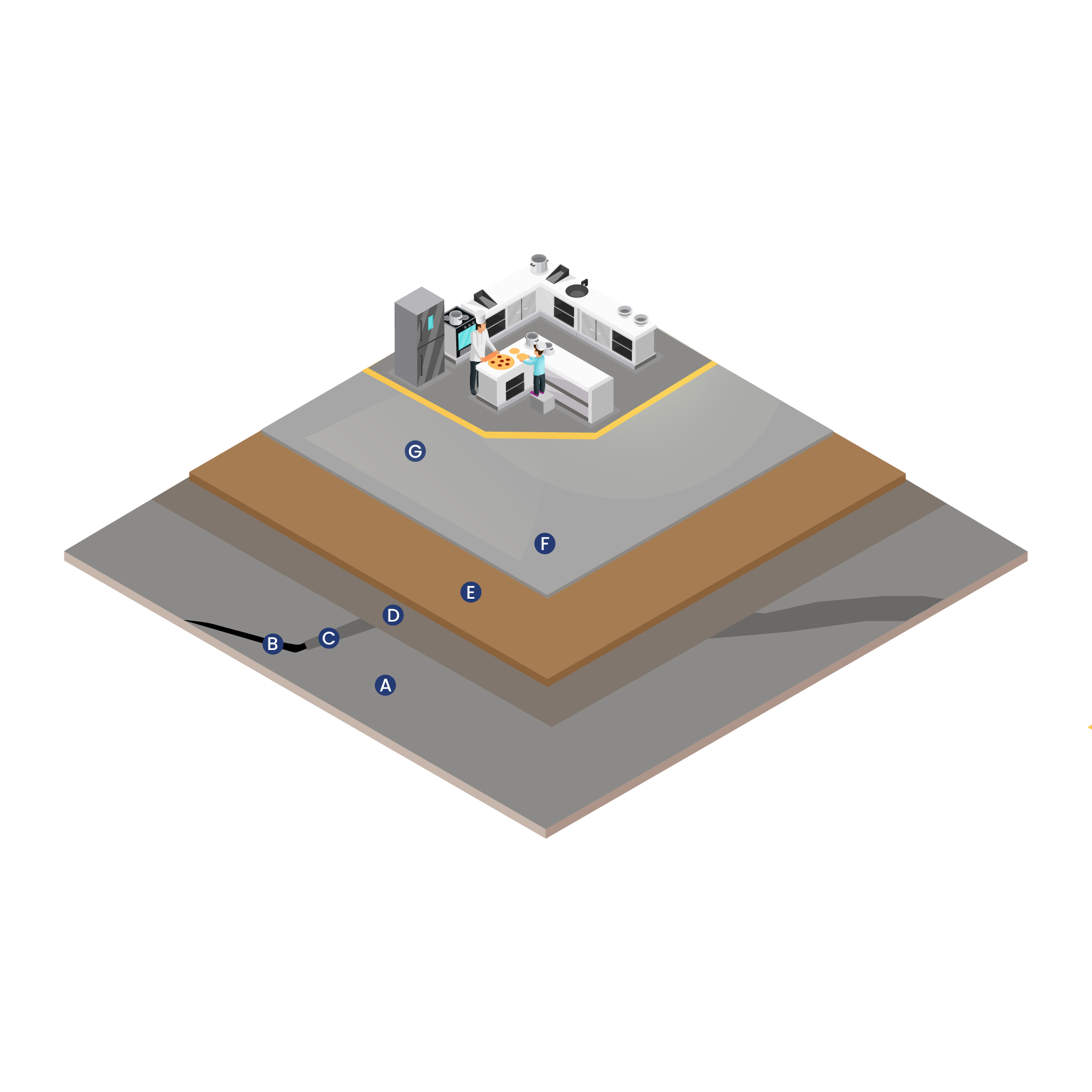
A Cementitious Surface: (Concrete slab or screed)
B Cracks and surface damage
C Crack Filler and Repairing Materials
D Ressi EPO Primer LV
E Ressi EPO Mid Coat S – GP
F Ressi EPO Tough Might Econo / Ressi EPO Floor Plus Econo
G Ressi EPO Roll Coat (Marking)