
Solvent-based epoxy flooring contains an organic solvent carrier that evaporates as the coating forms its film. Solvent-free epoxy is formulated without an added evaporative solvent, so it can support a different coating build and application method. Both still depend on the resin, hardener, concrete condition and installation specification; the formulation label alone does not tell you which floor will last longer.
For a factory, warehouse or commercial floor in Pakistan, the useful question is not simply which option sounds stronger. It is which product and complete flooring system suit the traffic, exposure, substrate and working conditions at that site.
What do “solvent-based” and “solvent-free” mean?
A solvent-based epoxy contains organic solvents that help adjust its viscosity and application properties. Those solvents leave the applied film as it dries, while the epoxy resin and hardener also react to cure. The finished dry-film build therefore depends on the product’s solids content and the thickness permitted by its technical data sheet.
A solvent-free epoxy has no added evaporative solvent carrier. Many such flooring products are described as high-solids or 100%-solids formulations, but those terms should be checked against the individual product data sheet. Without a solvent carrier leaving the film, suitable products can be specified for a higher build in one application. That does not make every solvent-free formulation identical or automatically suitable for every floor. Sherwin-Williams’ comparison of epoxy formulations explains why each category has different application characteristics and uses.
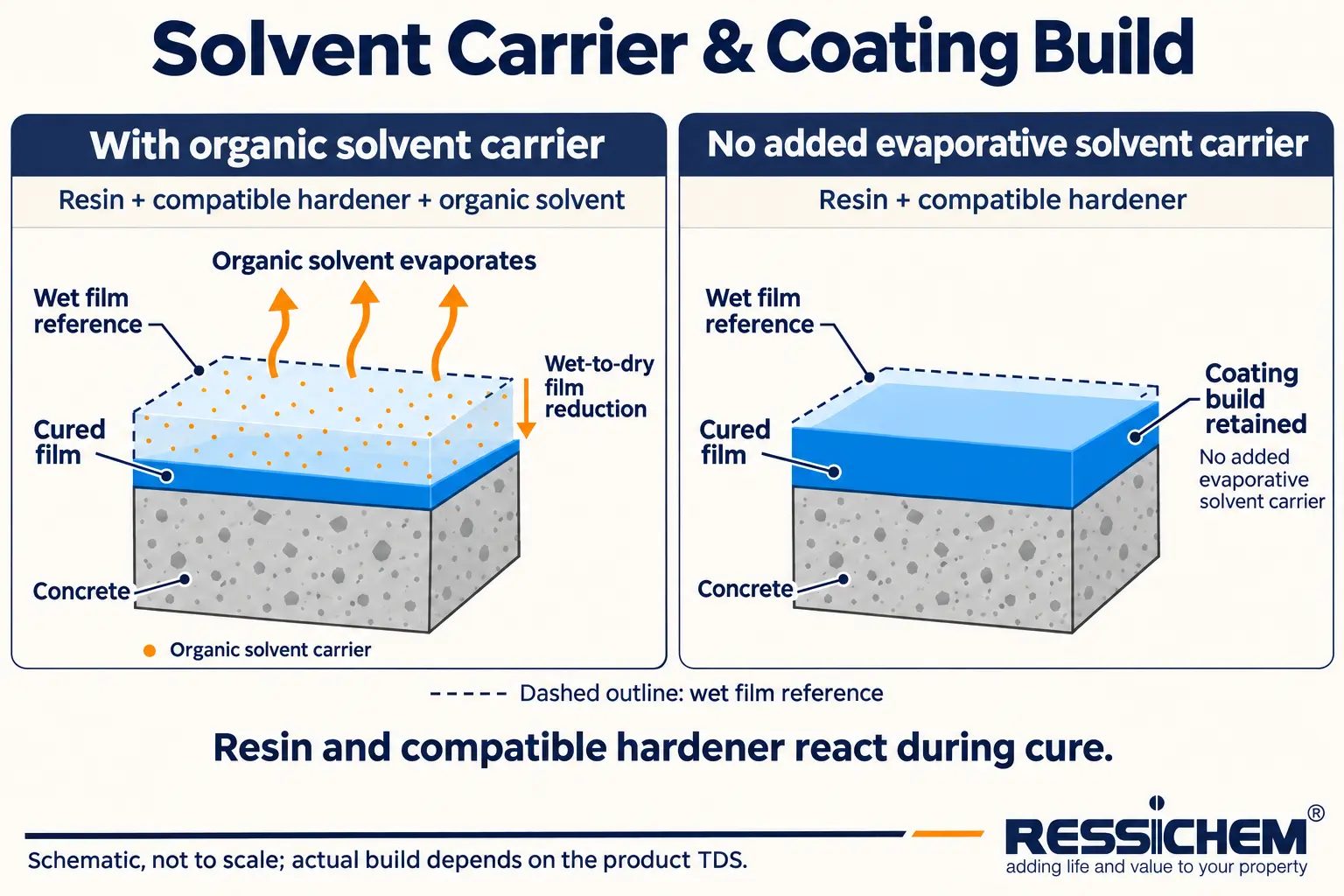
Solvent-free vs solvent-based epoxy flooring: key differences
Factor | Solvent-based epoxy | Solvent-free epoxy |
Carrier | Contains an organic solvent carrier. | Formulated without an added evaporative solvent carrier. |
Film build | Some applied volume leaves with the solvent. Check permitted dry-film build. | Can support higher build where the product data permits. Check specified thickness. |
Application | Viscosity and working time depend on the product. | Viscosity and working time also depend on the product; may need different placement methods. |
Solvent-related emissions | Solvent evaporation requires controls specified in the safety data sheet. | Less solvent evaporation; uncured components still require safety controls. |
System fit | Judge by site conditions and the named product’s data sheet. | Judge by site conditions and the named product’s data sheet. |
The comparison describes formulation characteristics, not a promise that one coating will outperform another. Read the exact product specification before comparing coverage, film thickness, recoat time or chemical resistance.
Which formulation is appropriate for your floor?
Start with the job the floor must do. A light-use commercial area, a workshop exposed to oils and cleaning chemicals, and a warehouse with wheeled traffic can require different finishes and system builds. The formulation is one decision within the wider specification, alongside concrete preparation, primer compatibility, required thickness and maintenance.
A solvent-based product may be considered where its specific application characteristics and permitted film build fit the project. A solvent-free product may suit a project that needs a compatible high-build system with less solvent evaporation during application. Neither choice should be made from the label alone: review the product’s technical data sheet, safety data sheet and site conditions. Water-based epoxy is a third formulation category; it should not be confused with either solvent-free or solvent-based epoxy.
Does solvent-free mean safer or more durable?
“Solvent-free” describes the absence of an added evaporative solvent carrier. It does not mean the uncured resin and hardener are harmless, odorless, suitable for unventilated work, or automatically low in every type of emission. Follow the selected product’s safety data sheet and the site’s controls for handling, ventilation and protective equipment. The US National Institute for Occupational Safety and Health notes that uncured epoxy and resin components can present hazards.
Durability also has to be specified, not assumed. Abrasion or chemical resistance, surface finish, moisture tolerance and service life depend on the actual product, prepared substrate, system build and exposure. A solvent-free floor can fail if the concrete is unsuitable or the installation does not follow the approved specification; a solvent-based product can be suitable when its documented properties fit the job.
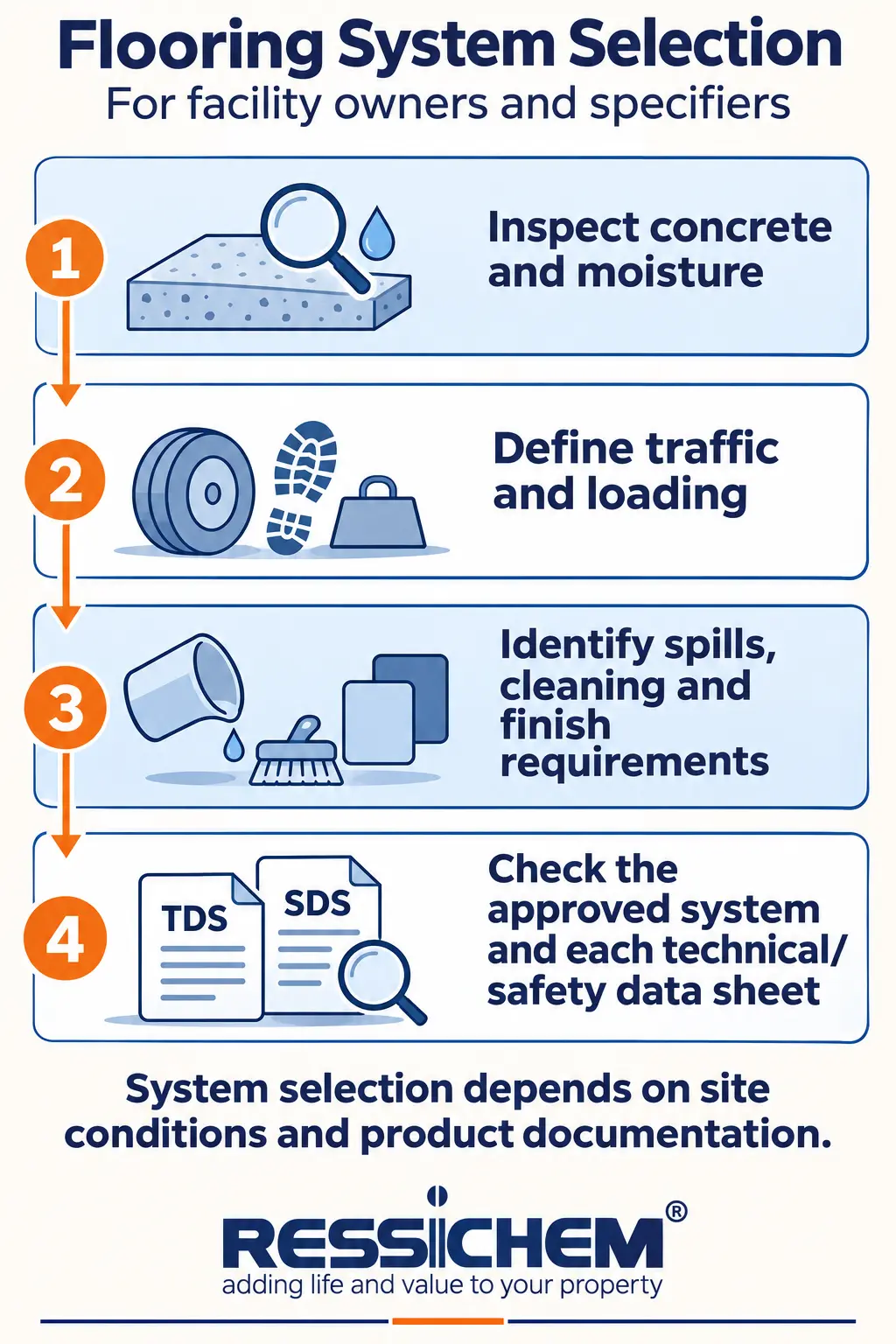
What should you check before specifying an epoxy floor?
Concrete and moisture
Assess the concrete for contamination, weak material, cracks and moisture before choosing a primer or coating. A product described as solvent-free is not automatically a moisture barrier. Ressichem lists Ressi EPO Primer LV as a solvent-free primer for concrete with high absorption, while other primers address different conditions. Select the primer using the relevant product documentation and site assessment.
Traffic, exposure and finish
Record the expected foot and vehicle traffic, point loads, chemical spills, cleaning routine and required surface finish. Match those conditions to the product’s documented use and the complete system specification. For instance, Ressichem describes Ressi EPO Tough Might as a solvent-free flooring product for heavy-duty, impact-resistant applications and Ressi EPO Chem Plus as a solvent-free option developed for chemical resistance. Those descriptions are starting points for selection, not interchangeable performance guarantees.
Application and curing conditions
Check the manufacturer’s preparation instructions, mixing ratio, usable working time, permitted coat build, recoat window and curing requirements for every selected component. These values vary by product and site temperature. Do not assemble a primer, body coat and finish from separate product pages without confirming that Ressichem specifies them together for the application.
Explore Ressichem’s flooring materials and systems
Ressichem supplies epoxy primers, coatings and flooring materials for different applications. Its Ressi EPO Primer LV, Ressi EPO Tough Might and Ressi EPO Chem Plus pages document examples of solvent-free products with distinct roles. Their mention here does not prescribe them as one combined build-up. Browse the epoxy flooring products for materials, or explore epoxy flooring systems by application to identify a relevant starting point. For a project specification, share the floor’s substrate condition, traffic and exposure requirements with Ressichem and request the appropriate technical data sheets.